


What are Schüssler salts?
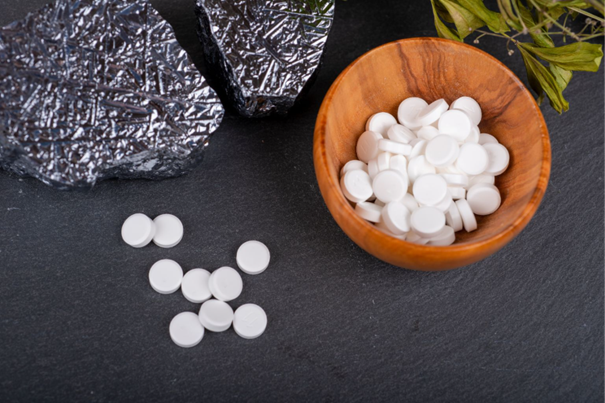
Schüssler salts are homeopathically prepared mineral salts used in naturopathy. They were developed by Dr. Wilhelm Heinrich Schüssler, who believed that a balanced mineral balance is an important foundation for physical well-being.
The Schüßler method focuses not on high doses of minerals, but on their use in potentized form. The mineral salts are intended to gently support the body and are traditionally used for everyday ailments as well as to promote regeneration and inner balance.
Schüßler salts are available today in various forms, such as:
- tablets
- Globules
- Drops
- Powders
- Creams
Discovery of Schüßler Salts
In the 19th century, Dr. Wilhelm Heinrich Schüßler developed what is known as “Schüßler Biochemistry.” He discovered that a total of 12 mineral salts are present in the human body and proposed the theory that health complaints might be linked to an imbalance in mineral levels.
This led to the development of Schüssler salt therapy, which originally consisted of 12 basic salts and was later expanded to include additional supplementary salts.
To this day, Schüssler salts remain very popular and are used both in naturopathic practice and for self-treatment.
What Schüssler salts are available?
Schüßler’s theory encompasses various mineral salts, which are traditionally assigned specific functions and areas of application. In addition to the original basic salts, there are supplementary salts that have expanded the concept over time.
1. The 12 Basic Salts
Schüßler therapy is originally based on 12 so-called basic salts or “functional remedies.” They form the foundation of Schüssler therapy and are traditionally used to support various processes in the body.
2. Well-Known Schüssler Salts
Among the best-known Schüssler salts are:
- Calcium fluoratum
- Calcium phosphoricum
- Ferrum phosphoricum
- Potassium chloratum
Each salt is traditionally associated with specific properties and areas of application.
3. Supplementary Salts
Later, the original Schüßler theory was expanded to include additional so-called supplementary salts. These are intended to complement the classic basic salts and cover additional areas of application.
4. Different Areas of Application
Schüßler salts are traditionally associated with topics such as:
- Energy
- Regeneration
- Metabolism
- Skin and connective tissue
- Nerves and inner balance
What are Schuessler salts made of and how are they produced?
Schuessler salts are based on specially processed minerals that are prepared through potentization. Depending on the application, this results in various dosage forms such as tablets, drops, creams, or spagyric sprays.
1. Minerals as a foundation
Schüssler salts consist of specially prepared minerals that are traditionally used to support various bodily functions.
2. Potentized processing
The minerals are potentized in a manner similar to homeopathy, meaning they are gradually diluted and processed.
3. Production in various potencies
Schuessler salts are often produced in so-called D-potencies such as D6 or D12. In this process, the mineral is mixed multiple times with a carrier substance and further processed.
4. Various dosage forms
After production, Schüßler salts are further processed depending on their intended use—for example, into:
- tablets
- Globules
- Drops
- Creams
- Powders
5. Spagyric processing
Some manufacturers—such as Zimply Natural—also combine Schuessler salts with spagyric processes and process them into products such as sprays.

Schüßler salts are traditionally produced by potentizing and processing special mineral salts into various dosage forms such as tablets, drops, or creams.
The spagyric Schuessler salts from Zimply Natural
The first four Schuessler salts are among the best-known basic salts in Schuessler therapy. They are based on natural minerals and are traditionally assigned to different functions and areas of application.
No. 1: Calcium fluoratum
Calcium fluoratum is traditionally associated with elasticity and stability and is frequently used in connection with the skin, connective tissue, and joints.
No. 2: Calcium phosphoricum
This Schüssler salt is considered a classic mineral salt for building, growth, and regeneration and is traditionally used especially during stressful periods.
No. 3: Ferrum phosphoricum
Ferrum phosphoricum is often associated with energy, concentration, and resilience and is traditionally used for exhaustion or physical strain.
No. 4: Kalium chloratum
Kalium chloratum is traditionally associated with mucous membranes, skin, and internal balance.