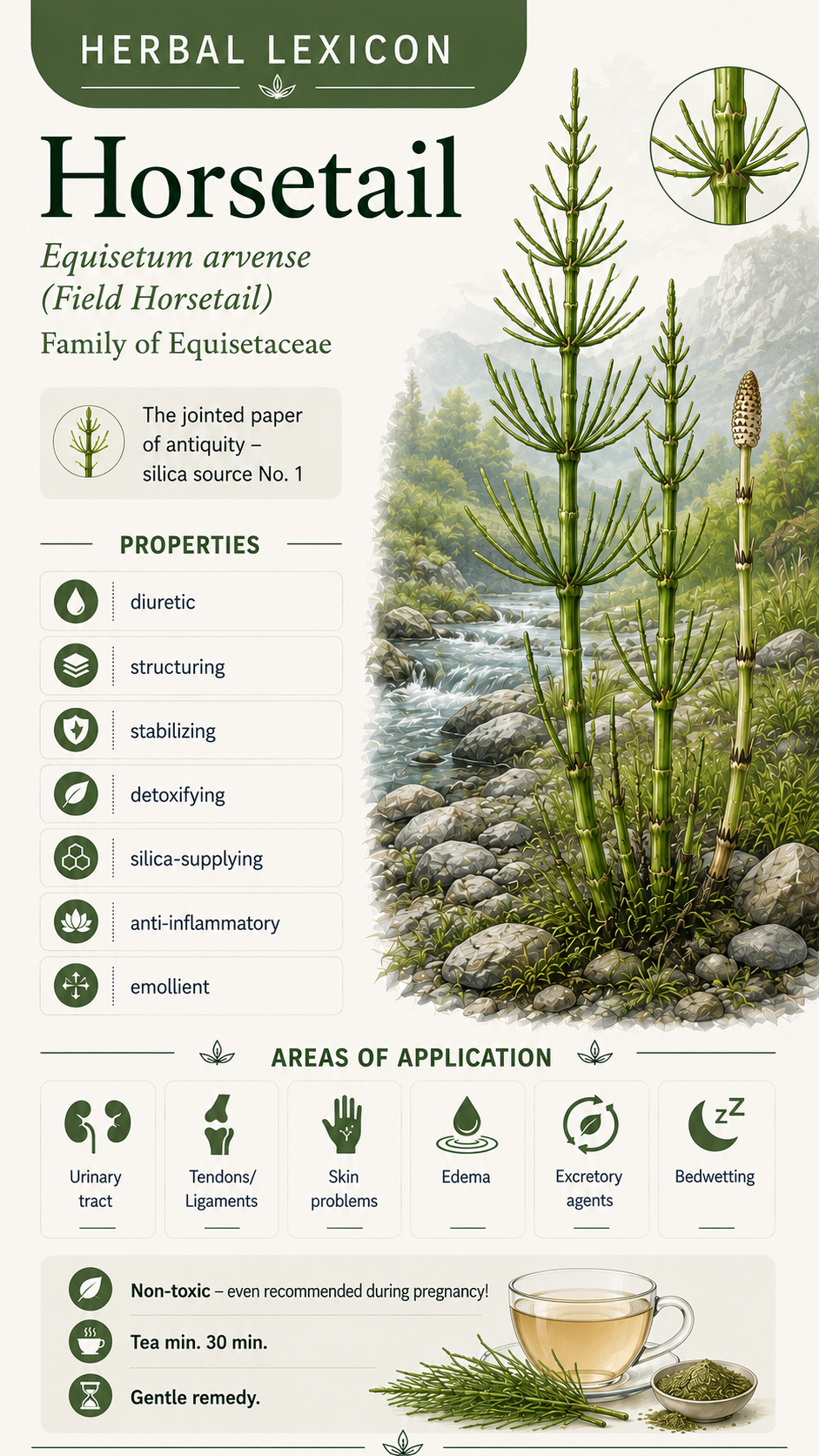

The sandpaper of antiquity – the number one source of silica. Even recommended during pregnancy! Slow-acting remedy – takes months. Let the tea steep for at least 30 minutes. NOT for cardiac or renal edema.
Interesting facts about horsetail
- The stems of horsetail are covered with a hard layer of silica (Mohs hardness 6–7)—in ancient times, they were used to polish tin, copper, and wood.
- Horsetail liquid fertilizer is an effective remedy for fungi and pests in gardening—the silicic acid strengthens plant cell walls against fungal infection.
- In Japan, horsetail is still grown today as a vegetable (tsukushi) and eaten as a delicacy in spring cuisine.
Effects & Properties
Silicic acid (SiO₂, 5–8% of dry matter): After absorption, it is stored in connective tissue as soluble orthosilicates. Silicic acid is a cofactor for prolyl hydroxylase—the enzyme that cross-links procollagen into stable collagen. More silicic acid = more stable collagen in the skin, ligaments, tendons, and bones. It also binds to inflammatory byproducts and excretes them via the kidneys. Potassium chloride: breaks down inflammatory tissue adhesions. Flavonoids: antioxidant, anti-inflammatory. Let the tea steep for at least 30 minutes!
Features: draining, firming, stabilizing, detoxifying, silica-rich, anti-inflammatory, purifying.
Applications
Horsetail as a detoxifying agent
Chronic inflammation leaves behind inflammatory byproducts in the connective tissue. When metabolism slows down in these areas, these byproducts accumulate and perpetuate the chronic inflammation. Silicic acid improves microcirculation in the connective tissue by activating collagen synthesis and capillary formation: inflammatory byproducts are removed through improved lymphatic and blood flow, and the kidneys excrete them. This process is slow—taking months to years—but profound.
Equisetum arvense for ligament and tendon weakness
Ligaments and tendons are composed of 70–80% type I collagen—their tensile strength depends directly on the quality of the collagen. A deficiency in silicic acid leads to insufficient prolyl hydroxylase activity: procollagen is not fully hydroxylated, and the cross-linking of collagen fibrils is suboptimal—ligaments become softer and tear more easily. Horsetail provides soluble silicic acid as a cofactor: collagen becomes more densely cross-linked, and ligaments and tendons become more resilient. People who frequently sprain their ankles benefit after months of use.
Horsetail for skin problems
Psoriasis and atopic dermatitis are partly caused by an overload of the kidneys’ excretory capacity: the skin is called upon to act as a secondary excretory organ—metabolites are excreted through the skin and trigger inflammatory reactions. Horsetail relieves the skin by stimulating primary excretion through the kidneys. For external use as a concentrated decoction: Silicic acid penetrates the skin, has an astringent effect, and inhibits local inflammation.
Equisetum arvense as a remedy for kidney and bladder conditions
Horsetail flavonoids (isoquercetin) stimulate renal filtration: more primary urine is produced, and inflammatory products, uric acid, and excess tissue fluid are excreted. The increased urine volume flushes bacteria out of the urinary tract. Unlike aggressive diuretics, horsetail does not deplete essential electrolytes.
Instructions for Use
Tea: Let steep for at least 30 minutes. Take 3 times a day for months to years. A slow-acting remedy!
Pregnancy & Breastfeeding
Even recommended during pregnancy: reduces swelling, supports kidney function, and strengthens ligaments and bones. The baby benefits from the supply of silicic acid.
Cardiac and renal edema
DO NOT use in cases of edema caused by heart failure or kidney disease—determine the cause.
Plant Profile
- Scientific name: Equisetum arvense L.
- Plant family: Horsetails (Equisetaceae)
- Other names: Horsetail, pan-scrubber, scouring herb
- Flowering period: does not flower (spore-producing plant)
- Origin: Local, cosmopolitan
- Toxicity: Non-toxic