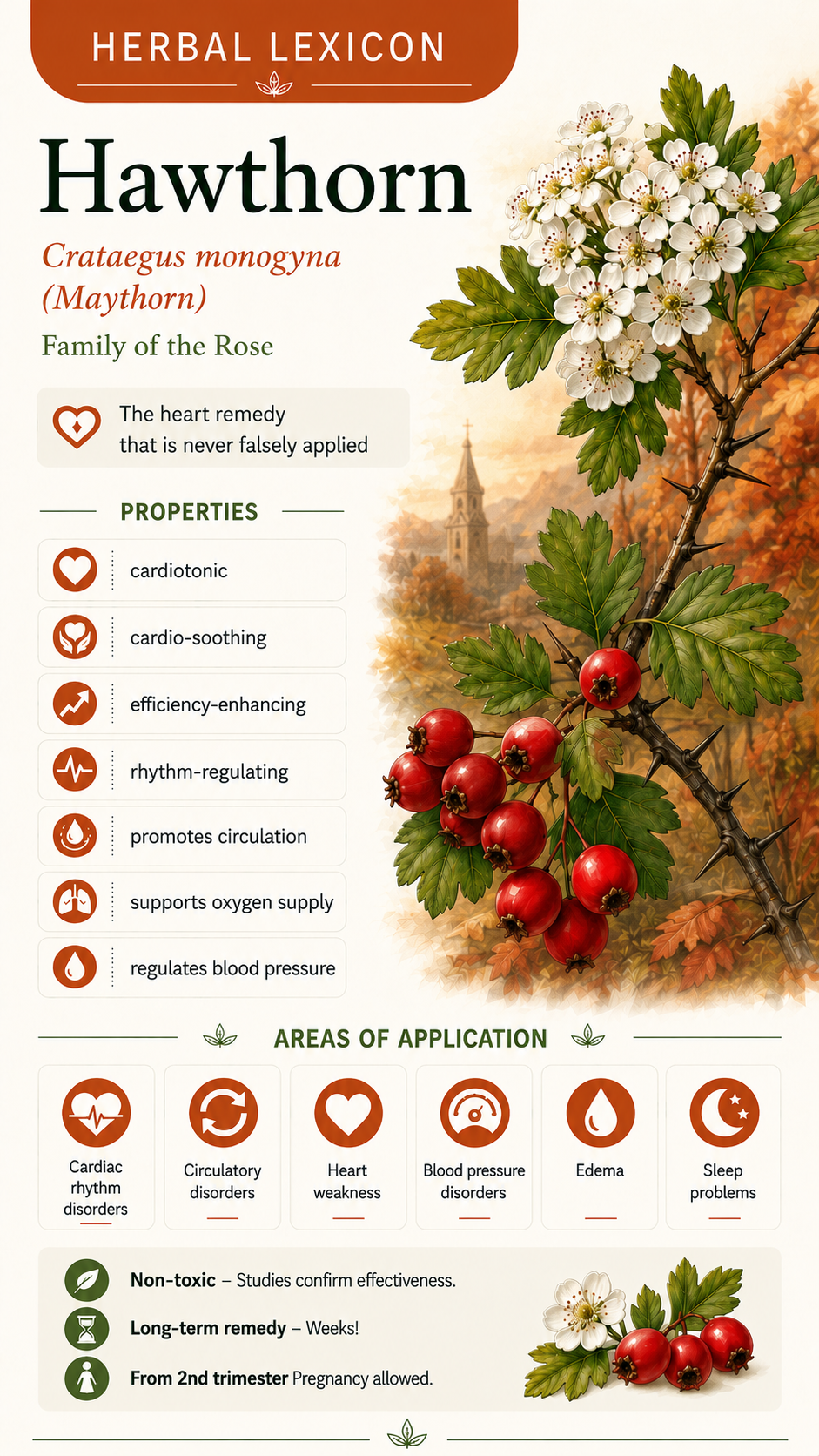

One of Europe’s three sacred thorns—the heart remedy that “can never be used incorrectly.” Clinically proven to strengthen the heart, regulate heart rhythm, and normalize blood pressure in both directions. A long-term remedy—it takes weeks to see the first effects.
Interesting facts about hawthorn
- According to Christian tradition, Jesus’ crown of thorns was made of hawthorn—a plant that has been regarded as a sacred protective plant for centuries.
- Native Americans (the Iroquois, the Algonquin) also used hawthorn as a heart herb—a remarkable cross-cultural parallel.
- Hawthorn extract (WS 1442) has the most extensive clinical evidence base of any heart-health supplement—involving over 5,000 patients in controlled studies.
Effects & Properties
Oligomeric proanthocyanidins (OPC) + flavonoids: They inhibit an enzyme (phosphodiesterase) that normally acts as a brake on the heart muscle. When this brake is released, the heart pumps more forcefully—without the toxicity risks associated with cardiac glycosides.
Increase in the stimulus threshold: Hawthorn prolongs the resting phase of the heart muscle after each contraction. Uncontrolled extra beats (extrasystoles) can no longer occur during this prolonged resting phase—the heart rhythm stabilizes.
Coronary dilation: Flavonoids relax the coronary arteries, allowing more oxygen to reach the heart muscle.
Features: Heart-strengthening, heart-calming, rhythm-regulating, blood pressure-regulating, coronary-dilating, antioxidant.
Applications
Hawthorn for heart arrhythmias
Heart rhythm disorders are often caused by electrically unstable areas in the heart muscle that fire uncontrollably and trigger premature heartbeats. These are triggered by oxygen deficiency, electrolyte imbalances, or autonomic nervous system imbalances. Hawthorn prolongs the resting phase of the heart muscle after each contraction: Uncontrolled extra impulses are too weak to trigger a new contraction during this prolonged resting phase. The heart beats more regularly.
Crataegus monogyna for heart failure (NYHA Class I–II)
In heart failure, the heart muscle can no longer pump enough blood—resulting in shortness of breath, edema, and exhaustion. Hawthorn strengthens the heart muscle: Phosphodiesterase inhibition increases the energy compound cAMP in the heart muscle cells—the heart contracts more strongly and pumps more blood. Clinical studies confirm improved exercise tolerance in NYHA Class II patients—without the risks associated with cardiac glycosides.
Hawthorn for blood pressure problems
Hawthorn normalizes blood pressure in both directions: when blood pressure is too low, it strengthens the heart so that more blood is pumped. When blood pressure is too high, the flavonoids relax the vessel walls (via the release of nitric oxide)—the arteries dilate slightly, and resistance decreases. This bidirectional normalization makes hawthorn a true all-rounder for the cardiovascular system.
Crataegus monogyna for anxiety and sleep problems
A noticeably rapid heartbeat often prevents sleep—the autonomic nervous system is overactive, and the body cannot relax. Hawthorn calms the cardiovascular and nervous systems: the heart rate slows, and the heart recedes into the background of consciousness. Patients experiencing the typical trio—a noticeable heartbeat, inner restlessness, and sleep disturbances—benefit particularly from it.
Instructions for Use
As a tea, as a single remedy, or as a compound, taken several times a day. Long-term treatment—it may take at least 4–8 weeks to see the first effects. Always consult a doctor in cases of serious heart disease.
Pregnancy & Breastfeeding
First trimester: use with extreme caution. From the second trimester onward, acceptable if necessary—no known risks, but no direct clinical data. Consult your healthcare provider.
Plant Profile
- Scientific name: Crataegus monogyna Jacq.
- Plant family: Rosaceae
- Other names: Hagedorn, single-thorned hawthorn
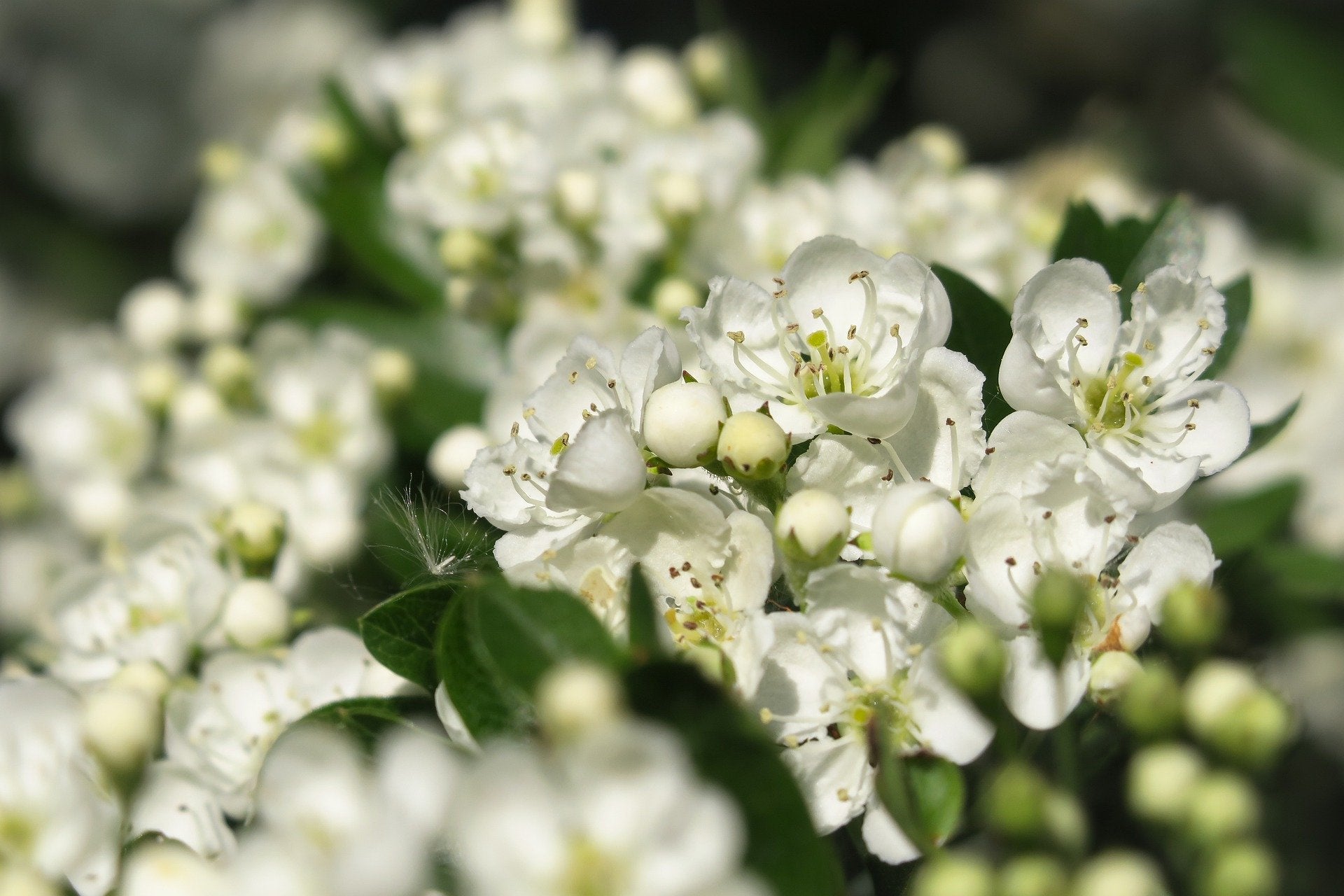
- Flowering period: May through June
- Origin: Europe, West Asia, North Africa
- Toxicity: Non-toxic