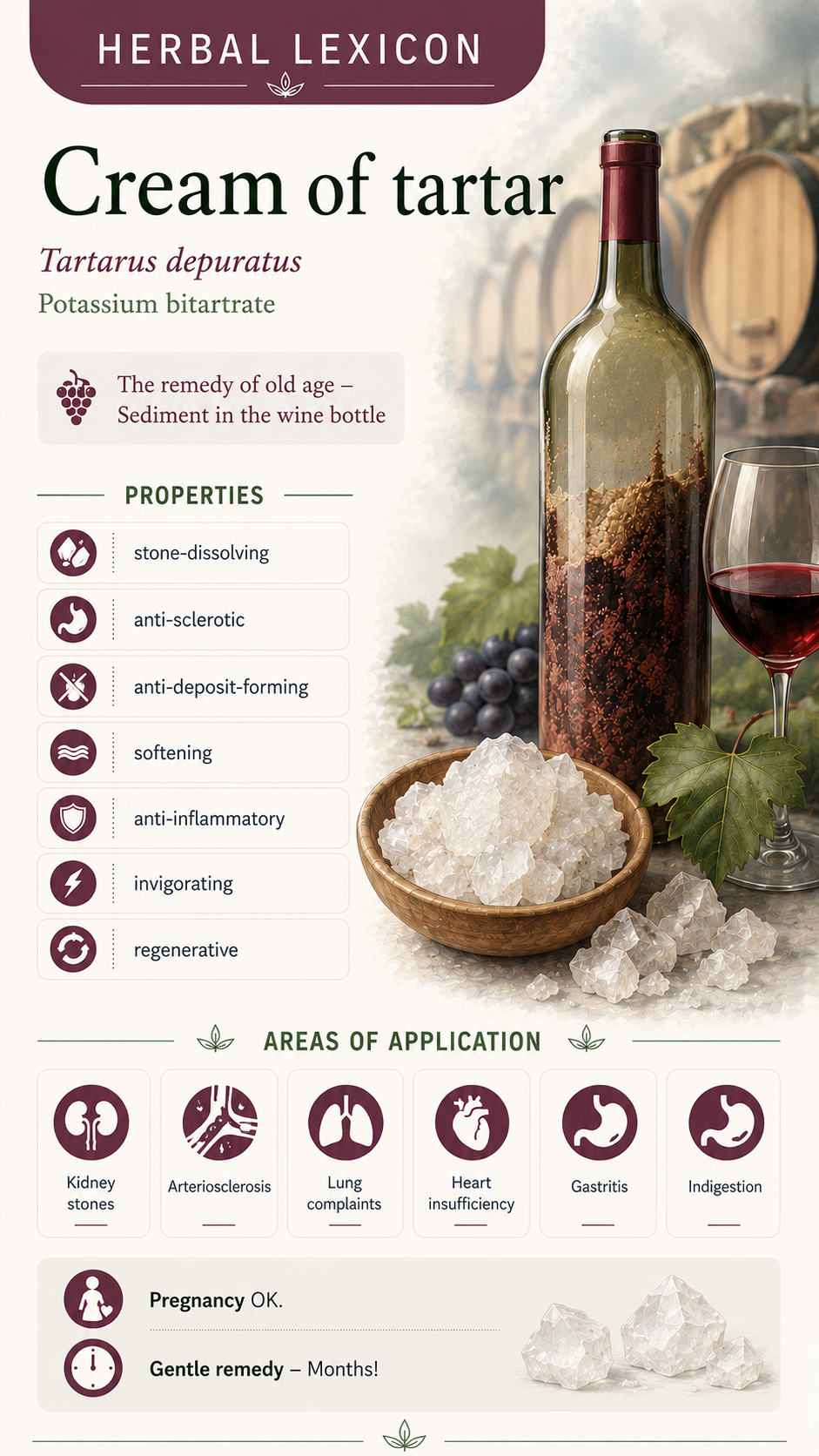

The sediment in a wine bottle as a remedy—tartar dissolves what has hardened, calcified, and fallen out of sync with the body’s natural rhythm. Slowly but deeply. It takes months to take effect.
Interesting facts about Weinstein
- Tartar is a leavening agent used in heavy doughs—when regular baking powder isn't strong enough—and helps stabilize beaten egg whites.
- The name Tartarus comes from Greek mythology: Tartarus is the deepest part of the underworld, where the Titans are held captive—frozen in time, far removed from life. This is precisely the image that lies behind metabolic disorders.
- Wine crystals form during the pressing and aging of wine: when cooled, tartaric acid and potassium combine to form insoluble crystals that settle at the bottom of the bottle.
Effects & Properties
Potassium hydrogen tartrate (C₄H₅KO₆): This organic potassium salt of tartaric acid acts as a complexing agent in spagyric preparations: It increases the solubility of calcium deposits—calcium oxalate in kidney stones, calcium phosphate in blood vessel walls, and calcifications in the bronchi and heart muscle—making them gradually more soluble so they can be excreted.
Antisclerotic effect: Hardened blood vessel walls regain their elasticity through improved blood flow and the formation of complexes. This is a slow process—taking months to years.
Features: Litholytic, anti-sclerotic, anti-calcific, emollient, anti-inflammatory, regenerative.
Applications
Tartar in Kidney Stones
Kidney stones form when urine becomes supersaturated with insoluble compounds—usually calcium oxalate—and these compounds crystallize. As an organic chelate molecule, potassium hydrogen tartrate increases the solubility of calcium ions in urine—similar to citrate, which is used in conventional medicine for kidney stone prevention. Tartrate ions bind calcium ions, prevent crystallization, and can gradually reduce the size of existing stones. Patience is required—kidney stones have formed over months.
Tartarus depuratus for atherosclerosis and heart failure
Atherosclerosis causes the blood vessel walls to harden: calcium deposits form, the arteries lose their elasticity, blood pressure rises, and the heart must pump against increased resistance. Tartaric acid has an anti-sclerotic effect by forming complexes with the calcium deposits in the blood vessel walls: elasticity slowly returns, the heart muscle becomes more flexible, and blood pressure gradually decreases. This is a long process—but one without side effects.
Tartar for chronic gastritis
In chronic gastritis, the stomach lining becomes scarred over time—the scar tissue is poorly supplied with blood, poorly nourished, and has little ability to regenerate. Tartar restores this sclerotic tissue to an active metabolic state: the scar tissue becomes softer and better supplied with blood, allowing the mucous membrane to regenerate. It is useful as a long-term adjunct therapy following the primary treatment.
Instructions for Use
A slow-acting remedy—do not expect quick results. Requires regular use for months to years. Low dosage. Spagyrically prepared.
Pregnancy & Breastfeeding
Safe to use during pregnancy and breastfeeding. Since these issues typically affect older women, treatment is often more appropriate after pregnancy.
Mineral Profile
- Content: Tartarus depuratus (potassium hydrogen tartrate)
- Other names: Tartar, cream of tartar
- Chemical formula: C₄H₅KO₆
- Characteristics: White, crystalline powder
- Origin: Wine Pressing – Grape Sediment
- Application: Deposits, sclerosis, hardening