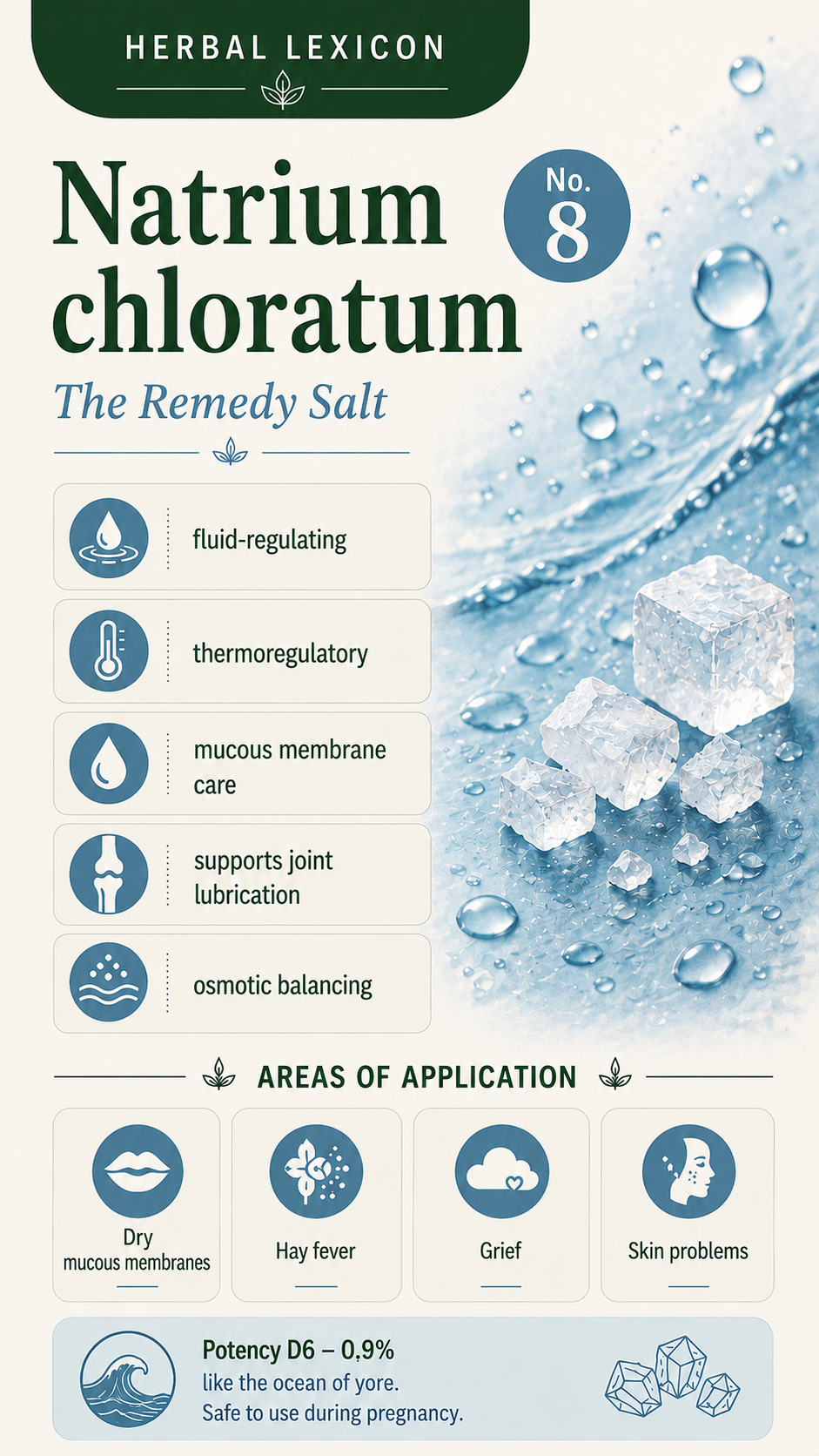


Table salt as a Schüssler salt—and a fascinating natural phenomenon: a 0.9% salt concentration in the cell, just like in the primordial ocean.
Interesting facts about Natrium chloratum
- Prehistoric oceans: 0.9% sodium chloride—the same as in human cells.
- A strong craving for salt = a possible sign of kidney problems and a deficiency in sodium chloride.
- In classical homeopathy: Natrium muriaticum.
Effects & Properties
Present in every cell of the body at a constant level of 0.9%—essential for life. Regulates water uptake and release in cells, forms synovial fluid and Muzin (mucilage) and maintains osmotic pressure. Thermoregulatory: supports the regeneration of tendons, ligaments, and cartilage.
Features: fluid-regulating, thermoregulatory, soothing to the mucous membranes, and osmotic-balancing.
Storage Locations & Deficiency Symptoms
All cells, blood, mucous membranes. Symptoms of deficiency:
- Dry mucous membranes (eyes, nose, mouth)
- Dry skin, poor wound healing
- Hay fever, watery eyes and a runny nose
- Grief, depression, withdrawal (the salt of sorrow)
Applications
Sodium chloride for dry mucous membranes
Dry mucous membranes—in the eyes, nose, or mouth—occur when the mucous membrane cells do not produce enough mucin (a mucous substance). Sodium chloride provides the building block that mucous membrane cells need to produce mucin. The mucous membranes regain their natural moisture, and the burning sensation and dryness subside.
Sodium chloride for hay fever
With hay fever, the nasal mucous membranes overreact to pollen—resulting in excessive mucus production, a runny nose, and itchy eyes. This overreaction occurs when the fluid balance of the mucous membranes is disrupted. Natrium chloratum regulates the absorption and release of water by the mucous membrane cells and curbs excessive mucus production.
Sodium Chloratum for Grief and Depression
In Schüssler’s theory of mineral salts, Natrium chloratum is known as the “salt of sorrow.” Persistent grief, silent mourning, emotional withdrawal, and depressive moods indicate a deficiency of Natrium chloratum. In these states, the body “holds on to” fluid—both figuratively and literally. Natrium chloratum helps restore the flow of emotions and fluids.
Sodium chloride for skin problems
Dry, cracked skin and poor wound healing occur when skin cells are unable to retain enough moisture. Sodium chloratum regulates water transport across cell membranes and stimulates cellular metabolism. This improves the regeneration of skin, tendons, and cartilage, and helps wounds heal more quickly.
Instructions for Use
Tablets 3 times a day or homeopathic pellets. For external use as an ointment. Can be taken over the long term.
Pregnancy & Breastfeeding
Without hesitation.
Profile
- Content: Sodium chloride (table salt)
- Description: Salt and fluid balance
- Distribution: All cells, blood, mucous membranes
- Schüssler No.: 8
- Typical potency: D6