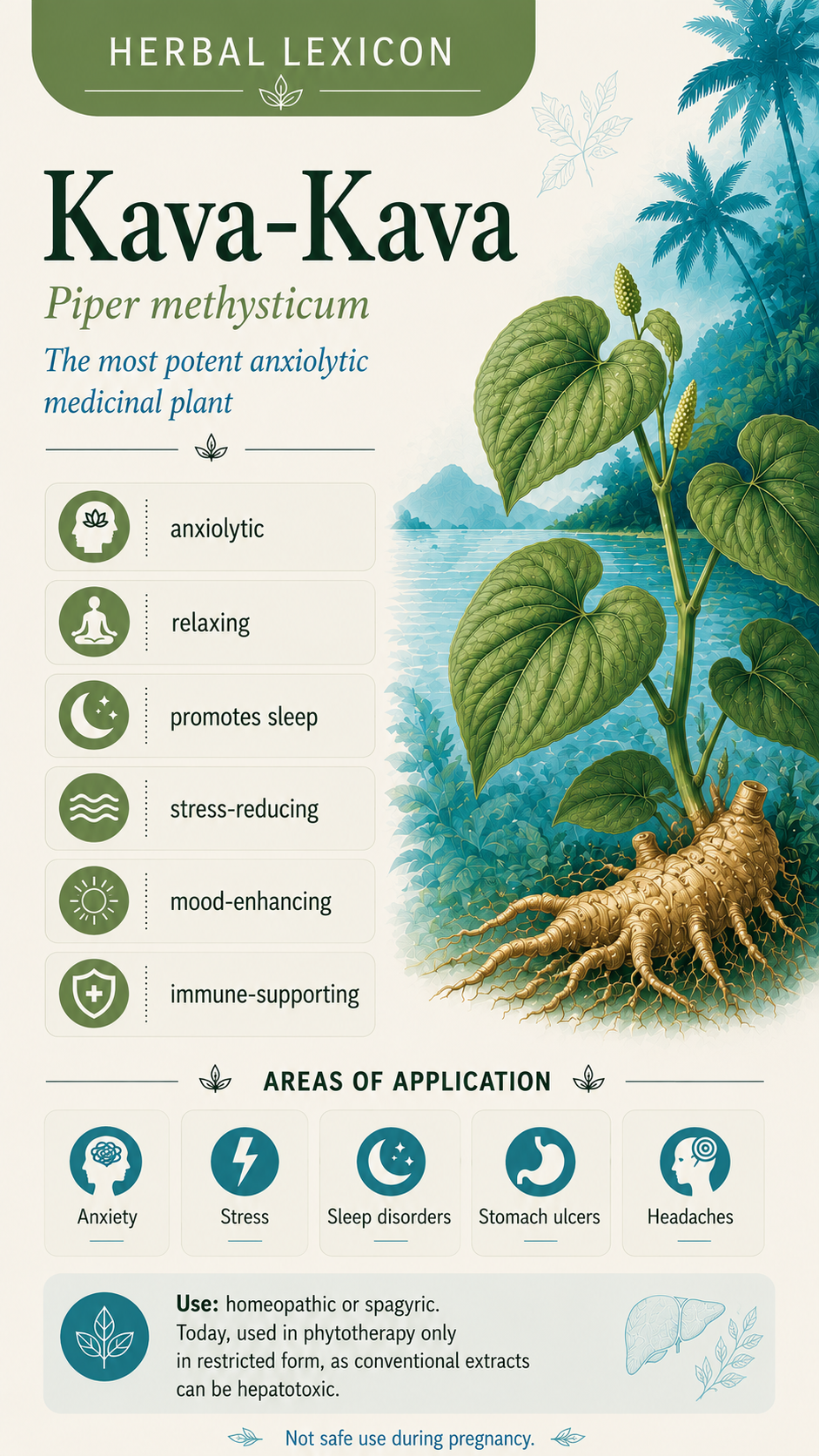

Polynesia’s sacred ritual plant for 3,000 years—the most potent anxiety-relieving plant in naturopathy. In Germany, it is available only as a homeopathic remedy or spagyric preparation.
Interesting facts about kava-kava
- 3,000 years of ritual use in Polynesia—no celebration is complete without kava.
- First European reports in 1616 (Le Maire and Schouten).
- USA: Hundreds of kava bars—a modern leisure trend.
Effects & Properties
cavalactones (Kawain, Methysticin): Acts similarly to benzodiazepines, but without the potential for dependence. Muscle relaxant. Local anesthetic (the tongue becomes numb upon contact). Not an emergency medication – Peak effectiveness after 4 weeks regular use.
Features: anxiety-relieving, relaxing, sleep-promoting, stress-reducing, mood-lifting, immune-boosting.
Only homeopathic or spagyric
In 2002, the BfArM revoked its approval as a phytotherapeutic agent after rare but severe cases of liver damage were reported following overdose. As Homeopathic remedy starting at D6 and as Spagyrics Kava-kava remains readily available.
Applications
Kava-kava for anxiety
In anxiety disorders, the brain is in a constant state of overstimulation—the threshold for alarm signals is lowered, and even the slightest stimulus triggers anxiety reactions. Cavalactones act similarly to benzodiazepines: they activate the inhibitory GABA receptors, reduce the brain’s hyperexcitability, and raise the anxiety threshold—without the potential for dependence and without the cognitive impairment associated with synthetic anxiolytics. Clinically proven; maximum effect after 4 weeks.
Piper methysticum for stress
Chronic stress keeps the central nervous system in a constant state of alert—cortisol and adrenaline levels remain elevated, making true relaxation nearly impossible. Kava-kava calms the central nervous system through the action of kavalactones on GABA receptors. Stress hormone levels drop, leading to a sense of overall relaxation—unlike benzodiazepines, this effect does not impair clear thinking.
Kava-kava for sleep disorders
Sleep disturbances caused by racing thoughts and anxiety occur when an overstimulated nervous system cannot wind down at night. Kava-kava stops these racing thoughts by reducing neural overstimulation, making it easier to fall asleep and stay asleep. It is particularly effective for anxiety-related sleep disturbances—without causing drowsiness the next morning.
Kava for Heartburn
Stress-related heartburn occurs when the sympathetic nervous system overstimulates stomach acid production while simultaneously causing the stomach muscles to spasm. Kava-kava calms the sympathetic nervous system and relaxes the stomach muscles through its muscle-relaxing effect. Stomach acid production returns to normal, and the heartburn subsides.
Kava-kava for headaches
Tension headaches are caused by underlying muscle tension in the neck and shoulder area, which builds up due to chronic stress. The muscle-relaxing effect of kavalactone relieves this underlying tension: the tense muscles relax, blood circulation improves, and the tension headache subsides.
Instructions for Use
In Germany only Homeopathic remedy ≥D6 or spagyric remedy. High doses should only be taken under a doctor's supervision to monitor liver function. Interactions with psychotropic drugs are possible.
Pregnancy & Breastfeeding
Contraindicated – insufficient safety data.
Liver problems
Contraindicated. When used in herbal medicine: Monitor liver function tests regularly.
Plant Profile
- Scientific name: Piper methysticum
- Plant family: Pepper family (Piperaceae)
- Other names: Rauschpfeffer, Kawa, Ava
- Flowering period: July through August
- Origin: Polynesia, South Pacific
- Toxicity: The roots are poisonous in large quantities