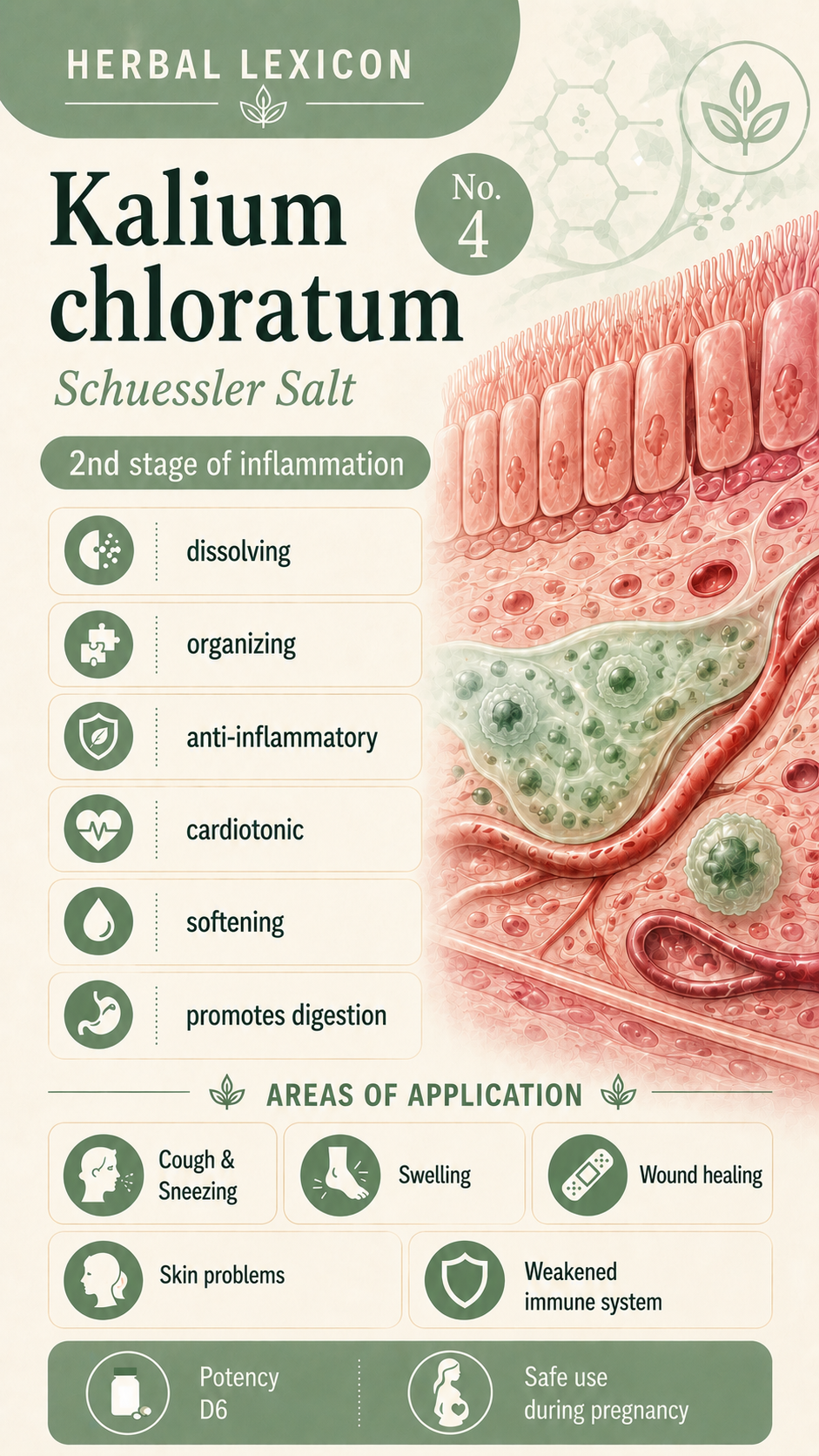

The salt of the second stage of inflammation—potassium chloride—keeps fibrin in solution and prevents pathological adhesions.
Interesting facts about potassium chlorate
- Food additive E508 as a flavor enhancer.
- An important component of potash fertilizer in agriculture.
- Clinical use in pulmonology: prevents the alveoli from sticking together in cases of pneumonia.
Effects & Properties
The second stage of inflammation is characterized by whitish, thick mucus, fibrin formation, and swelling. The body releases fibrin as a repair agent—the risk: chronicity due to pathological adhesions. Kalium chloratum helps Fibrin in solution and ensures a controlled healing process without adhesions.
Features: loosing, organizing, anti-inflammatory, cardiotonic, emollient.
Storage Locations & Deficiency Symptoms
All cells, blood, blood cells. Symptoms of deficiency:
- Panty cough, bronchitis, white coating on the tongue
- Swollen glands, immune deficiency, rosacea
- Wound healing disorders, adhesions
Applications
Potassium salt for coughs and colds
In the second stage of a cold, nasal mucus changes from clear and runny to whitish and thick—fibrin is deposited. If the cold stalls at this stage, it becomes chronic and develops into sinusitis. Kalium chloratum keeps the fibrin in solution, allowing the mucus to drain. The cold heals without complications and does not become chronic.
Potassium chloride for swelling
After injuries or surgeries, the body develops edema—fibrin is deposited to facilitate healing. Too much fibrin leads to pathological adhesions and persistent swelling. Kalium chloratum keeps the fibrin in solution at an optimal concentration: this allows healing to occur while preventing tissue adhesions. Function is preserved.
Potassium salts in wound healing
When wounds occur, the body produces fibrin as a natural bandage. Excess fibrin leads to scar tissue and adhesions. Potassium chloratum dissolves excess fibrin and restores optimal tissue function. Scars become smaller, adhesions dissolve, and the tissue functions normally again.
Potassium chloride for skin problems
Chronic skin conditions in the second stage—characterized by whitish, adherent scales or crusts—are caused by the accumulation of fibrin in the skin. Kalium chloratum resolves the chronic inflammation in the second stage and facilitates complete healing. The appearance of the skin improves significantly.
Potassium salts for immune deficiency and allergies
If the immune system is stuck in a chronic second stage of inflammation, it cannot fully recover. Potassium chloratum helps the immune system move through and complete this stage. The inflammation heals, the immune system can regenerate, and it is once again able to function properly.
Instructions for Use
As an ointment, tablets, or trituration. Take as a course of treatment, several times a day.
Pregnancy & Breastfeeding
Safe to use—no problem during pregnancy and breastfeeding.
Profile
- Content: Potassium chloride
- Description: Salt of the mucous membranes
- Distribution: All cells, blood, blood cells
- Schüssler No.: 4
- Typical potency: D6