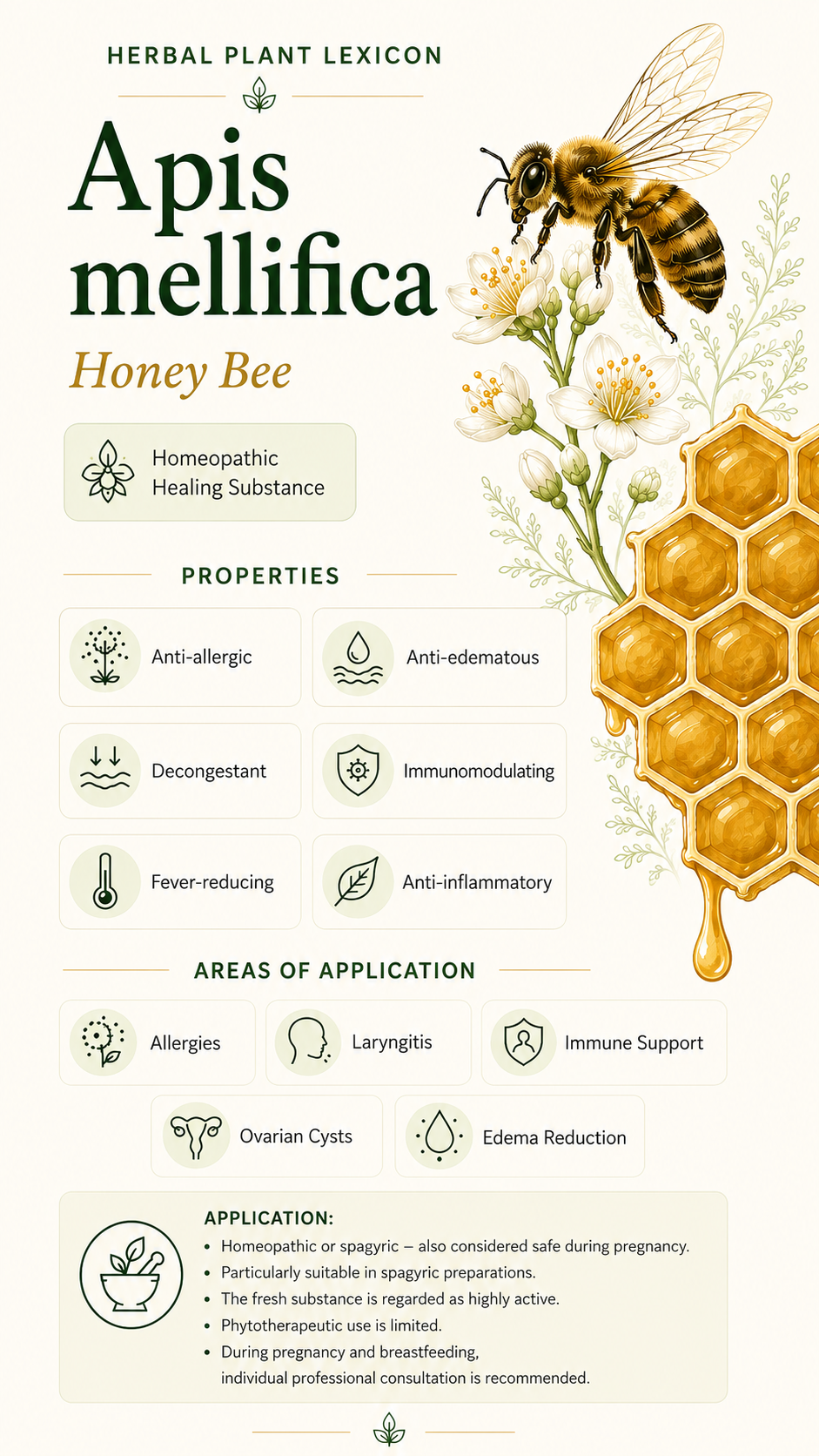


Bees have been associated with human civilization since its very beginnings. In medicine, bees are valued for their use in treating acute illnesses and as an important means of strengthening the immune system.
Interesting facts about Apis mellifica
The honeybee is much more than just a pollinator—its history and the substances it produces are medically remarkable.
- A queen bee lays up to 500,000 eggs in her lifetime.
- It takes between 900,000 and 6 million visits to flowers to produce 1 kg of honey.
- A bee colony produces about 100 kg of honey per year.
Effects & Properties
Apis mellifica is a preparation made from the entire honeybee, including its venom. In naturopathy, it is one of the most important remedies for inflammation and allergies. It is particularly effective for inflammation associated with Effusions and edema In cases where these symptoms occur together, Apis is used as a specific remedy. The target tissues are primarily serous membranes, such as those in the respiratory tract or joints. Active ingredients: proteins, formic acid, saponins, tryptophan, choline, fatty acids.
Features: anti-allergic, anti-edematous, decongestant, immunomodulatory, antipyretic, anti-inflammatory.
Applications
In Apis mellifica, the focus is usually on immune processes and tissue inflammation associated with effusions.
Apis mellifica for laryngitis
When the larynx becomes inflamed, edema forms beneath the mucous membranes, making it difficult to speak and breathe. The throat feels tight, and the voice becomes hoarse or fails entirely. Apis mellifica helps the body reduce the edema and alleviate the inflammation. The swelling subsides, and the voice and breathing become clearer and easier again.
Apis mellifica as an acute treatment for allergies
Apis is considered THE remedy for allergies. During an allergic reaction, the body releases histamine, causing tissues to swell and edema to develop—much like after a bee sting. Apis mellifica modulates the immune system, helping it recognize its excessive reaction and encouraging the body to reduce the edema. The swelling subsides more quickly. Apis is also used for desensitization during allergy-free periods to train the immune system over the long term.
Apis mellifica for boosting the immune system
Some immune systems are sluggish and respond too slowly to infections. Apis mellifica can be used as part of a stimulation therapy to boost the immune system—so that it responds more quickly to infections, detects pathogens early on, and fights them more effectively. The duration and severity of illness are reduced.
Apis mellifica for ovarian cysts
Ovarian cysts are often caused by inflammatory processes in the ovaries. Fluid accumulates, and cysts form. Apis helps the body reduce inflammation, break down the accumulated fluid, and dissolve the cyst. This relieves pressure on the ovaries, allowing them to resume their normal function.
Instructions for Use
Apis is generally used as an acute remedy and, in such cases, is taken up to every half hour for a very limited period of a few days. Prophylactic therapies for desensitization or cyst treatment may last several weeks—in which case Apis mellifica is usually three times a day administered orally.
Pregnancy & Breastfeeding
Apis mellifica can be taken safely even during pregnancy and while breastfeeding.
Use in patients with allergies
Since Apis mellifica is one of the primary remedies for allergies, allergies are not a contraindication but rather one of the main indications for its use.
Profile
- Content: Apis mellifica (honeybee with venom)
- Animal species: Apis mellifera (Western honeybee)
- Origin: Widespread worldwide
- Form of application: Homeopathic, spagyric
- Special feature: Acute-relief medications and desensitizing agents
- Toxicity: Safe to use in food preparation