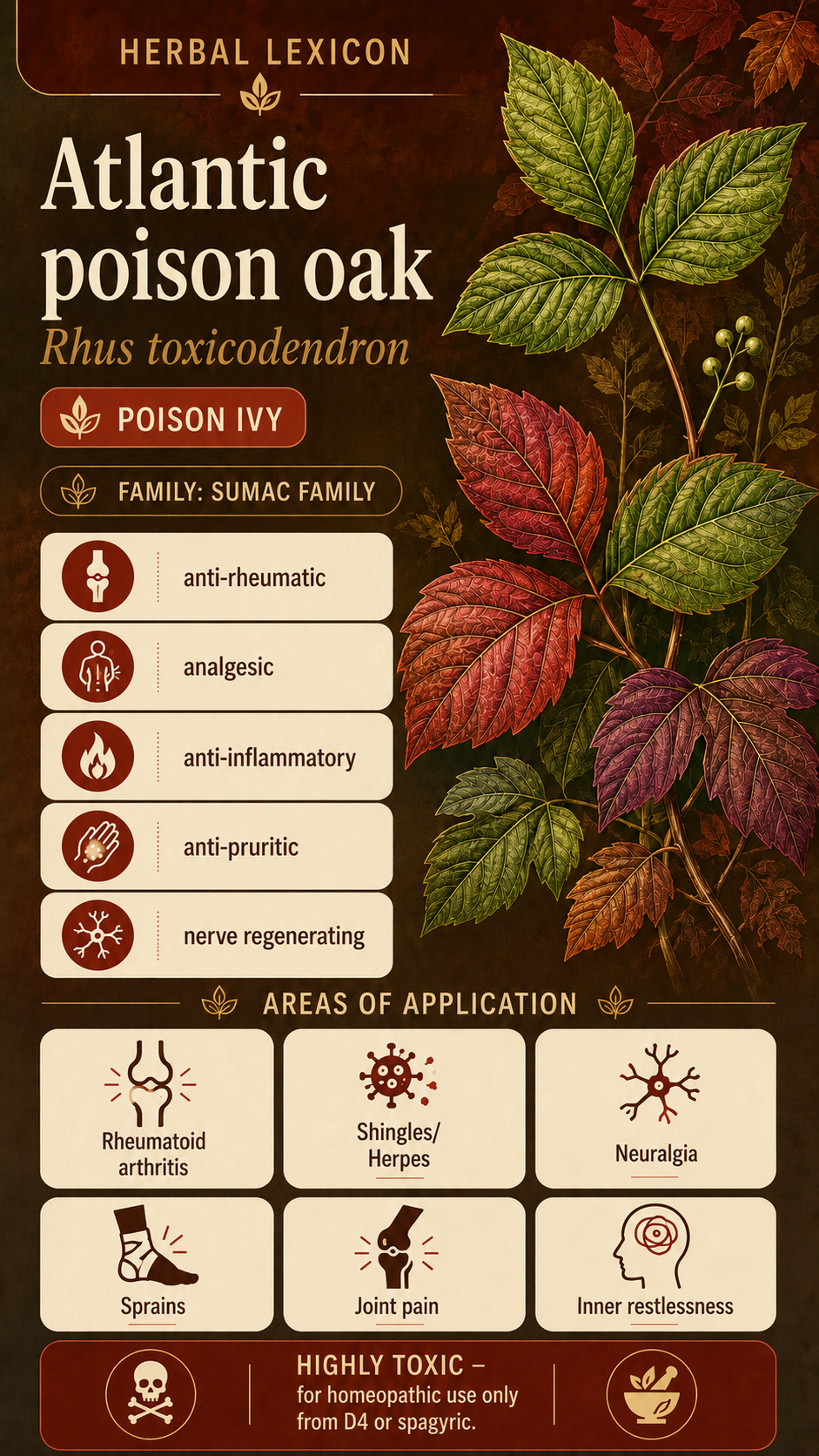

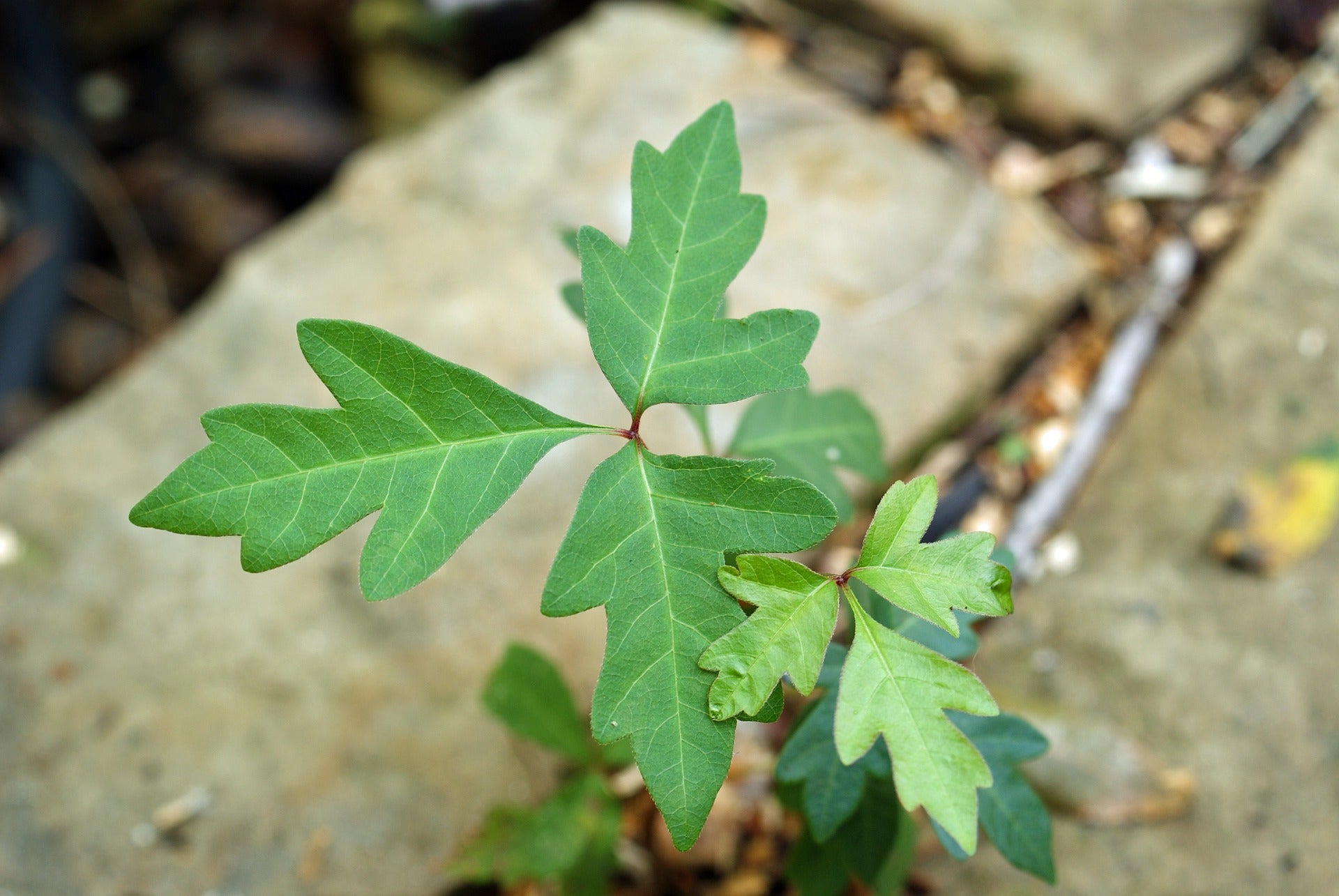
Feared as poison ivy—but indispensable as a homeopathic remedy for nerve pain and rheumatism.
Interesting facts about poison ivy
- Even simply standing next to a poison ivy plant can cause skin irritation due to the urushiol it releases.
- Houses in the U.S. with poison ivy were considered haunted—residents suffered from unexplained pain.
- Skin contact: severe blisters requiring medical treatment.
Effects & Properties
Its atropine-like effect on the central nervous system explains its use in Shingles, herniated disc, and trigeminal neuralgia. Urushiol is the most potent contact allergen in the world—in homeopathic preparations, this very property is used for therapeutic purposes. Key characteristic: burning pain of an inflammatory nature. Only homeopathic or spagyric.
Features: anti-rheumatic, pain-relieving, anti-inflammatory, nerve-regenerating, itch-relieving.
Applications
The key symptom of poison ivy is a burning sensation—anywhere where there is a burning, hot pain with an inflammatory quality.
Rhus toxicodendron for ligament injuries
In cases of sprains and ligament injuries, the inflammatory response causes a burning, hot pain in the affected tissue. The nerves in the injured area are overstimulated and send continuous pain signals. Poison ivy inhibits nerve irritation through its atropine-like effect on the central nervous system, alleviates the inflammatory response, and allows the tissue to regenerate. Typical presentation: Pain starts as a burning sensation and improves with movement.
Sumac for headaches
A burning, throbbing headache with an inflammatory component—often accompanied by neck stiffness and a feeling of tightness in the head. The atropine-like effect of Rhus toxicodendron on the central nervous system reduces nervous overstimulation, causing the muscles to relax and the headache to subside.
Rhus toxicodendron for rheumatism
Rheumatic conditions are characterized by burning, aching pain in ligaments, tendons, and joints—especially in the morning after a period of rest. Poison ivy helps reduce nerve irritation in the inflamed tissues and has anti-inflammatory effects. A characteristic feature is that symptoms improve after warming up and with movement.
Poison ivy and fever
For fevers with a burning sensation—where the patient feels hot and restless, and the body feels as if it is burning from the inside—poison ivy helps counteract the inflammatory response that drives the fever. This relieves the burden on the immune system, lowers the body temperature, and allows the body to focus on its natural defense mechanisms.
Rhus toxicodendron for skin rashes with blisters
In cases of herpes simplex and shingles, nerve branches become inflamed—resulting in the classic blistering rash accompanied by severe, burning nerve pain. Poison ivy inhibits inflammation, soothes irritated nerves, and reduces the rash and itching. Since its effect is similar to atropine and targets the central nervous system, it is ideal for all nerve-related pain of an inflammatory nature.
Poison ivy and joint pain
Inflammatory joint pain accompanied by stiffness and a burning sensation responds exceptionally well to poison ivy. It counteracts the rheumatic-inflammatory component and reduces irritation of the nerve structures in the joint. Typically, the pain is worst in the morning and improves with movement.
Rhus toxicodendron for inner restlessness
Inner restlessness accompanied by agitation—the patient cannot sit still, tosses and turns in bed at night, and cannot find peace. The overstimulated nervous system can no longer relax. Poison ivy calms the overstimulated nerves through its effect on the central nervous system—calm and regeneration return.
Instructions for Use
As needed, several times a day for a few days to 2 weeks.
Pregnancy & Breastfeeding
Available in homeopathic/spagyric form—have the therapist determine the potency and dosage.
Important: Only homeopathic or spagyric
Highly toxic. Urushiol is the most potent contact allergen in the world. Never use it in its raw form.
Plant Profile
- Scientific name: Rhus toxicodendron
- Plant family: Sumac family (Anacardiaceae)
- Other names: Poison Ivy
- Flowering period: May through July
- Origin: North America
- Toxicity: Highly toxic – for homeopathic/spagyric use only