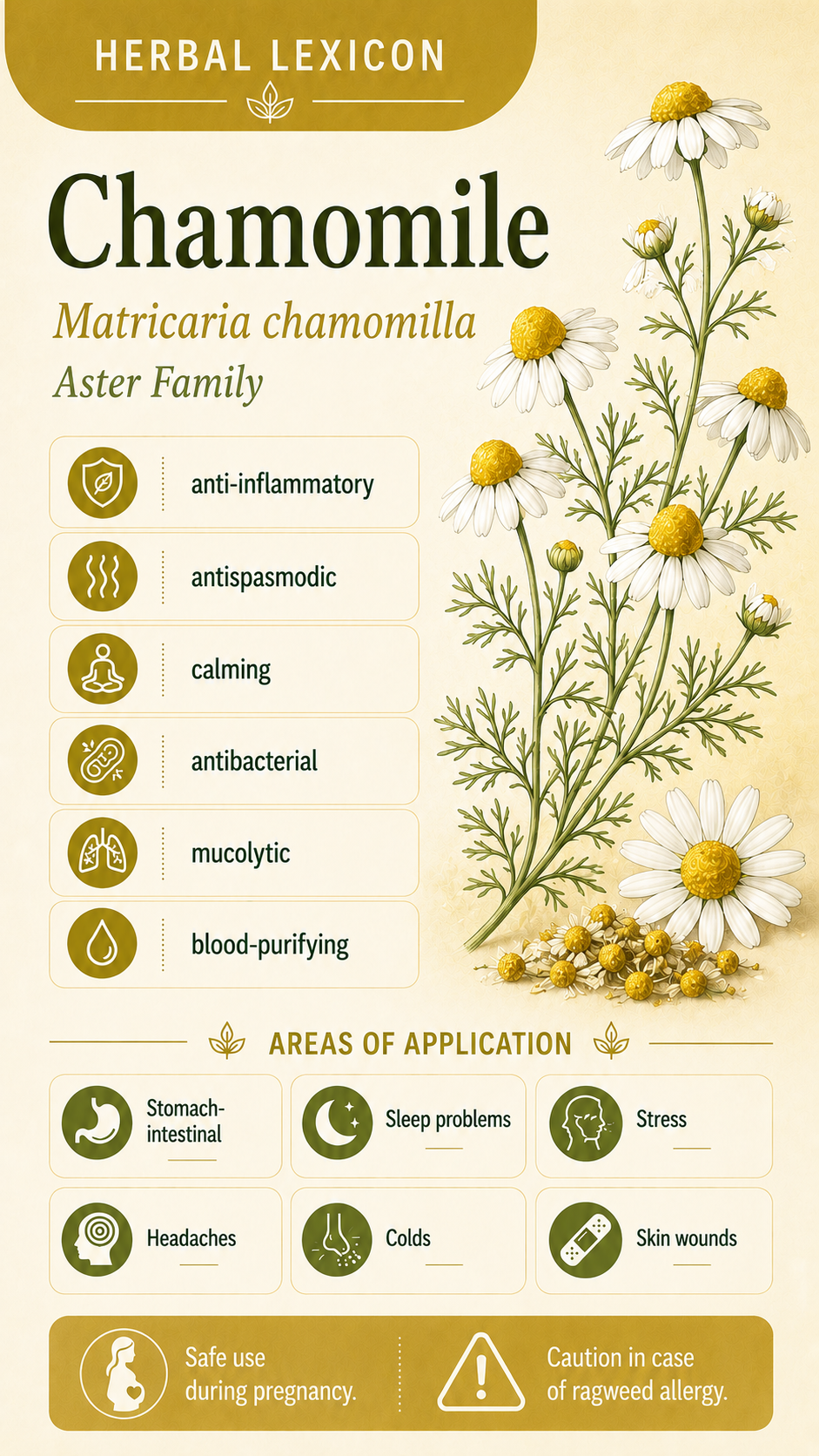


One of the world's best-known medicinal plants—versatile, well-researched, and everyone recognizes its scent.
Interesting facts about true chamomile
- Nearly extinct in the wild—it is removed from fields as a weed.
- In Western Europe, it is grown mainly in France.
- Grows in Tyrol at altitudes of up to 1,300 meters.
Effects & Properties
Alpha-bisabolol: anti-inflammatory for the skin and mucous membranes; accelerates wound healing. Apigenin: binds to benzodiazepine receptors in the brain – has a calming effect and promotes sleep, much like a mild natural sedative. Matricin → Chamazulene: the deep blue essential oil produced during distillation has antibacterial and anti-inflammatory properties.
Features: anti-inflammatory, antispasmodic, soothing, antibacterial, expectorant.
Applications
Chamomile for Sleep Problems
Sleep problems caused by nervousness and physical tension respond exceptionally well to chamomile. The flavonoid apigenin binds to the same receptors as benzodiazepines—which explains its reliable calming and sleep-promoting effects without the risk of dependency. At the same time, its antispasmodic effect on the stomach and intestines relieves the physical tension that prevents sleep.
Chamomile for Stress
Chronic stress keeps the sympathetic nervous system constantly activated—leading to digestive cramps, a racing heart, and inner restlessness. Chamomile helps relieve this overstimulation of the sympathetic nervous system through the effect of apigenin on the brain. Nervous cramps in the digestive tract subside, the body relaxes, and the stress response is dampened.
Chamomile for headaches
Tension headaches are caused by irritated mucous membranes (e.g., due to hay fever) or tense neck and shoulder muscles resulting from stress. Chamomile soothes irritated mucous membranes thanks to alpha-bisabolol and relaxes tense muscles through its antispasmodic effect. The root cause of the headache is addressed directly.
Matricaria chamomilla for hay fever
Hay fever causes inflammation of the nasal and ocular mucous membranes due to pollen entering the body. When inhaled, chamomile flushes pollen out of the airways, and the alpha-bisabolol it contains has a direct anti-inflammatory effect on the irritated mucous membranes. Swelling and watery eyes subside, and breathing becomes easier.
Chamomile for the Immune System
Chamomile stimulates the production of white blood cells, thereby strengthening the immune system’s non-specific defenses. Especially during cold season or after periods of exhaustion, regular consumption of chamomile helps the body respond more quickly to pathogens.
Matricaria chamomilla for heartburn
Heartburn is caused by excess stomach acid flowing back into the esophagus or by overstimulated stomach muscles. Chamomile soothes the stomach lining thanks to alpha-bisabolol, relaxes the stomach muscles through its antispasmodic effect, and reduces stress-induced stomach acid production. This helps relieve heartburn.
Chamomile for gastrointestinal problems
Bloating, cramps, and digestive discomfort are caused by spasms in the muscles of the intestines, stomach, and gallbladder. Chamomile is the classic antispasmodic for the entire digestive tract. It relaxes smooth muscles, relieves gas, and soothes irritated mucous membranes. It’s a classic remedy for bloating in children—and just as effective for adults.
Chamomile for skin wounds
For wounds and skin injuries, chamomile accelerates healing in several ways: alpha-bisabolol speeds up epithelialization, chamazulene has an antibacterial effect and prevents infections, and the mucilage forms a protective layer over the wound. Chamomile is a universal wound-healing remedy for the skin and mucous membranes.
Chamomile for skin and mucous membrane inflammation
Inflammation of the skin and mucous membranes—such as eczema, stomatitis, and vaginal inflammation—responds exceptionally well to chamomile. It has antibacterial, antiviral, and antifungal effects against a wide range of pathogens and exerts an anti-inflammatory effect on the affected tissues.
Instructions for Use
As tea, for inhalation, in aromatherapy, in creams, ointments, and drops.
Pregnancy & Breastfeeding
No concerns whatsoever—safe to use during pregnancy and while breastfeeding.
Allergy to composite flowers
Caution if you have a known allergy to composite flowers—this product may cause allergic reactions.
Plant Profile
- Scientific name: Chamomile
- Plant family: Asteraceae
- Other names: True chamomile
- Flowering period: May through July
- Origin: Native to (Europe)
- Toxicity: Non-toxic