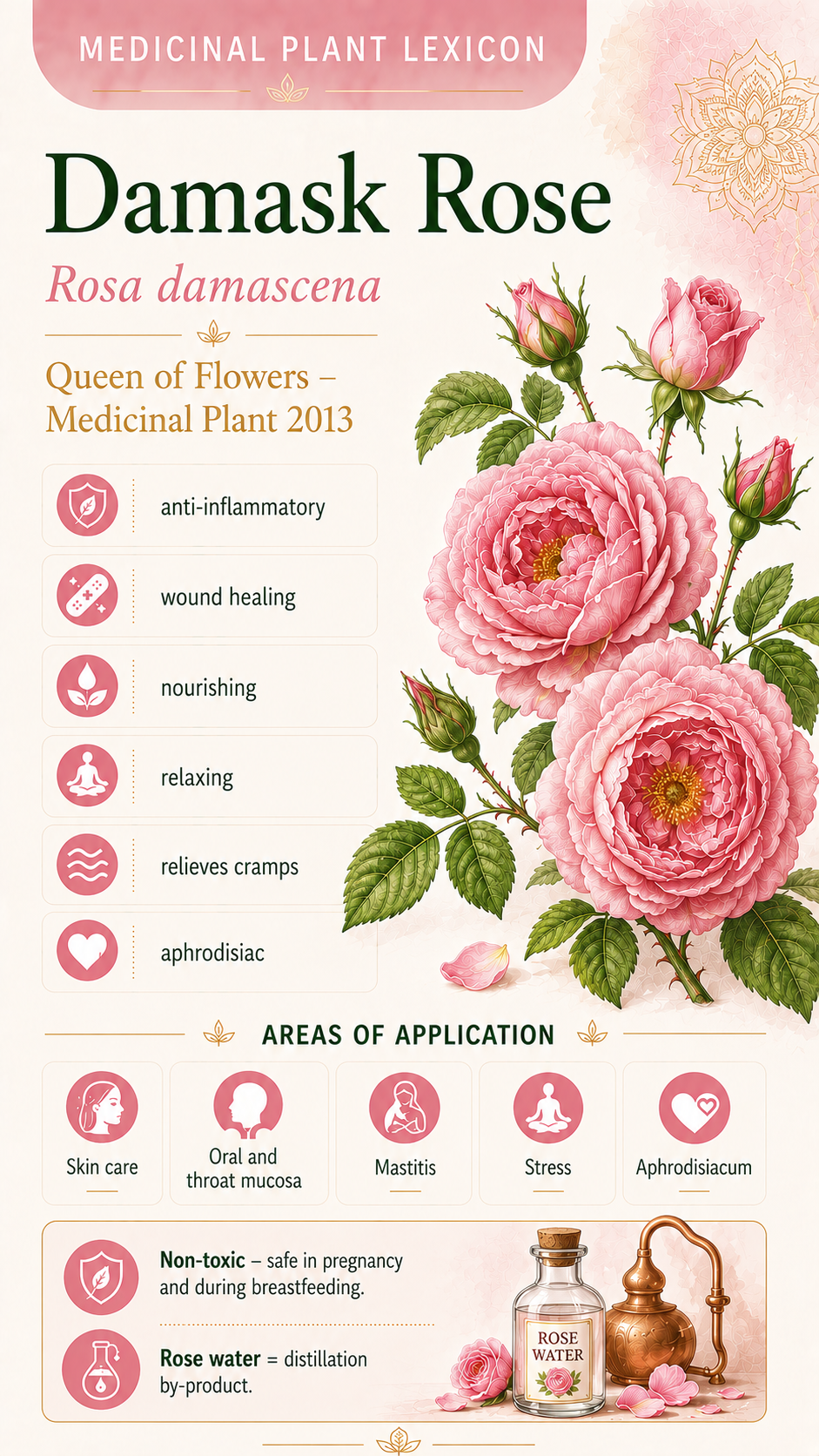


The queen of flowers and the medicinal plant of Venus, the goddess of love—the Damask rose combines beauty care with profound healing properties for both skin and soul.
Interesting facts about Rosa damascena
- Medicinal Plant of the Year 2013.
- The "War of the Roses": the English War of the Roses between the Lancasters and the Yorks—named after their coats of arms.
- Rose water is a byproduct of rose oil distillation—a gentle toner for the skin and mucous membranes.
Effects & Properties
The essential oil (Geraniol, citronellol) has relaxing, aphrodisiac, and antimicrobial properties. tannins have astringent and soothing effects on the mucous membranes. Their anti-inflammatory properties are effective on both the skin and the mucous membranes. It takes several tons of petals to produce 1 kg of rose essential oil—hence the high price.
Features: anti-inflammatory, wound-healing, nourishing, relaxing, antispasmodic, aphrodisiac.
Applications
Rosa damascena for skin problems
Healthy skin depends on a balanced microbiome—a harmonious balance of the bacteria that inhabit it. Skin irritation, inflammation, and dryness occur when this balance is disrupted. Rosa damascena nurtures the skin microbiome: the essential oil has an antimicrobial effect against pathogens, the tannins soothe irritated skin, and the moisturizing molecules keep the skin soft, supple, and radiant.
Rosa damascena for the mucous membranes of the mouth and throat
The mucous membranes in the mouth and throat become irritated, swollen, and sensitive to pain during colds, periodontal disease, and inflammation. Rosa damascena has an astringent effect due to its tannins and helps soothe the mucous membranes—inflamed tissue contracts, irritation subsides, and the mucous membranes can regenerate. Very effective as a mouthwash or in throat lozenges.
Rosa damascena for mastitis
Mastitis—an inflammation of the breast—often occurs during breastfeeding: milk congestion, cracked nipples, or bacterial infections can lead to pain, swelling, and redness. Rosa damascena has a local anti-inflammatory effect due to its essential oil, acts as an antimicrobial against skin bacteria, and promotes wound healing by stimulating tissue regeneration. When applied topically as an ointment or oily extract, it relieves pain and supports healing—and is completely safe during breastfeeding.
Rosa damascena for stress
Stress activates the sympathetic nervous system and keeps the body in a constant state of alert. The essential oil of the Damask rose acts directly on the limbic system—the emotional part of the brain—via the olfactory cortex. The stress response is dampened, cortisol levels drop, and the body relaxes. It is particularly effective for chronic stress when used in aromatherapy, in the bath, or as a room fragrance.
Rosa damascena as an aphrodisiac
For thousands of years, the rose has been associated with love and sensuality—and for good reason. Geraniol and citronellol stimulate areas of the limbic system—which govern emotions and sexuality—through the olfactory system (sense of smell). On an inner level, the rose has a relaxing effect and opens one up emotionally to intimacy. The effect is cumulative—not immediate, but rather atmospheric.
Instructions for Use
For internal use: drops, tea, homeopathic pellets. For external use: ointment, oil, rose water. Can be combined in many ways with other medicinal plants.
Pregnancy & Breastfeeding
Completely safe—also ideal for use during breastfeeding, even in cases of mastitis.
Plant Profile
- Scientific name: Rosa damascena
- Plant family: Rosaceae
- Other names: Damask rose, fragrant rose
- Flowering period: June through July
- Origin: Samos, the Near East
- Toxicity: Non-toxic