


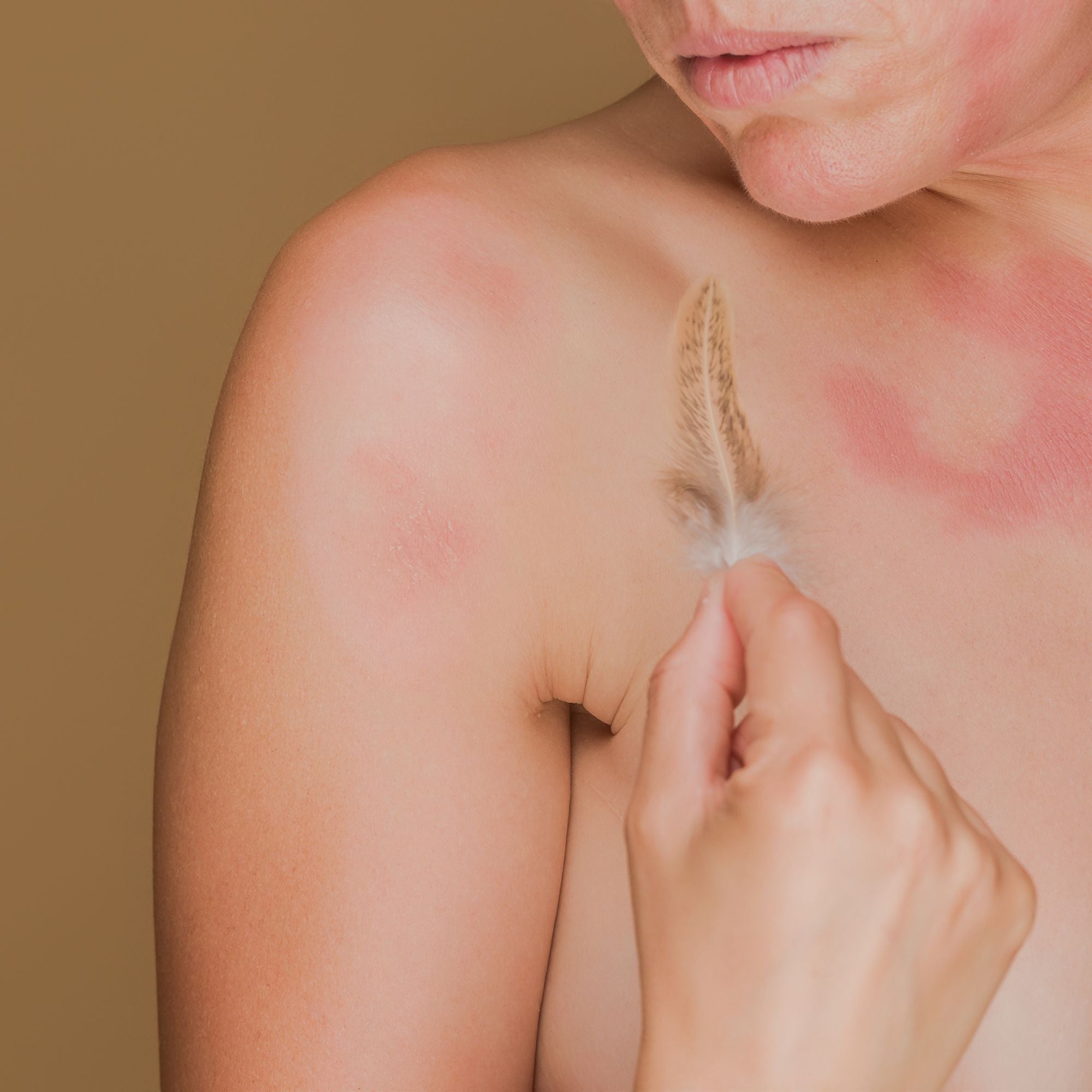
Why a Sun Allergy Isn't Really an Allergy
Many people believe that with a sun allergy, the sun itself is the problem. In fact, however, the skin does not react to sunlight as such, but rather to changes that UV rays trigger in the skin cells.
Strictly speaking, most forms of sun allergy are not classic allergies like hay fever or a dust mite allergy. Instead, they result from a misdirected reaction of the immune system to substances produced in the skin by UV radiation.
The most common form is what’s known as polymorphic light dermatosis. It often occurs at the start of the sunny season or on vacation, when the skin is suddenly exposed to significantly more sunlight than usual.
Interestingly, the skin of many people affected becomes less sensitive as the summer progresses. Experts refer to this as an “acclimatization effect,” which demonstrates how closely sun allergies are linked to the skin’s adaptive mechanisms.
Why Some Skin Reacts Hypersensitively to Sunlight
The exact cause of a sun allergy remains unclear to this day. However, researchers have identified several factors that can increase the risk.
1. UV rays alter processes in the skin
Sunlight consists of various types of radiation. UVA rays, in particular, play an important role in many forms of sun allergy.
When these rays penetrate the skin, they generate so-called free radicals and other metabolic byproducts. In sensitive individuals, these changes can activate the immune system. The result is an inflammatory reaction that manifests as a rash, itching, or blisters.
This also explains why symptoms often don’t appear until several hours after sun exposure, rather than immediately during it.
2. The immune system overreacts
Normally, the immune system recognizes UV-induced changes as harmless.
In people with sun allergy, this assessment appears to be partially disrupted. Certain immune cells react more strongly to the resulting skin changes and trigger inflammatory processes.
This creates a vicious cycle: The inflammation makes the skin more sensitive, which can in turn trigger further reactions.
3. Skin type, genes, and external factors interact
Not everyone develops a sun allergy.
People with fair skin are particularly likely to be affected. Their skin produces less melanin, the natural substance that protects against UV rays. As a result, more UV rays reach deeper layers of the skin.
In addition, genetic factors can play a role. Medications, cosmetics, fragrances, or hormonal changes can also increase light sensitivity and exacerbate existing symptoms.
How to Recognize a Sun Allergy
Symptoms usually appear on areas of skin that have been exposed to sunlight for the first time or to particularly intense sunlight. These often include the décolletage, shoulders, arms, or the outer sides of the legs.
1. Itching is often the first warning sign
Many people do not initially notice a rash, but rather an unpleasant itching sensation.
This occurs because inflammatory mediators activate certain nerve endings in the skin. The itching often begins just hours after being in the sun.
Interestingly, the intensity of the itching can be significantly stronger than the visible skin changes.
2. Small nodules and blisters instead of widespread redness
Unlike classic sunburn, a sun allergy often manifests as small red nodules, blisters, or pinpoint skin lesions.
These are caused by local inflammatory reactions and fluid accumulation in the tissue. This typical pattern also explains why many people affected do not initially think of sunburn.
3. The skin reacts only in certain areas
A notable characteristic is the distribution of the symptoms.
Often, the face or hands are spared, while the décolletage, upper arms, or shoulders are affected. The reason: These areas of skin are often covered in everyday life and are therefore less accustomed to sunlight.
4. Swelling and a burning sensation may also occur
In more severe reactions, additional symptoms occur alongside the itching.
These include:
- a feeling of tightness
- Burning
- Swelling
- A sensation of warmth in the skin
These symptoms are signs of a local inflammatory reaction and indicate how actively the immune system is responding to UV-induced changes.

Typical signs of a sun allergy include itching, small nodules or blisters, localized skin reactions, and swelling or a burning sensation after sun exposure.
These measures can make daily life easier
A sun allergy cannot always be completely prevented. However, many people with this condition find that certain behaviors can significantly relieve skin irritation. The key is to gradually acclimate the skin to sunlight and avoid additional irritants.
1. Gradually acclimate the skin to sunlight
Many symptoms arise when the skin is suddenly exposed to intense UV radiation after months with little sun.
Gradually increasing sun exposure can give the skin’s natural adaptation mechanisms time to adjust to the changed conditions. This is why sun allergies often occur at the beginning of summer or on vacation and improve for some people as the season progresses.
2. Use reliable UV protection
Sunscreen isn’t just for preventing sunburn. It can also help reduce the UV rays that trigger the skin reaction in the first place.
Broad-spectrum sunscreens, which protect against both UVA and UVB radiation, are particularly important. Since UVA rays play a central role in many forms of sun allergy, this protection should be explicitly stated on the product label.
3. Avoid the midday sun as much as possible
UV radiation often reaches its highest intensity between about 11 a.m. and 4 p.m.
Seeking shade during this time or, if possible, shifting activities to the morning or evening hours can significantly reduce the strain on your skin.
4. Make good use of protective clothing
Clothing is often the most effective form of sun protection.
Long-sleeved tops, lightweight pants, wide-brimmed hats, and special UV-protective fabrics can help shield sensitive areas of the skin from direct radiation. This can make daily life much easier, especially for people with recurring skin issues.
5. Care for the skin barrier
A healthy skin barrier helps better ward off external irritants.
Moisturizing skincare products can help support the skin’s natural protective function. Especially after prolonged exposure to the sun, soothing skincare can help reduce feelings of tightness and skin irritation.
Sun Allergy, Sunburn, or Another Skin Condition?
Not every skin reaction after a sunny day is automatically a sun allergy. In fact, various skin conditions are often confused with one another.
1. Sun allergy and sunburn—two different processes
Sunburn is caused by direct damage to the skin cells. The skin reacts with pain, redness, and sometimes blistering.
In contrast, a sun allergy is primarily characterized by an immune reaction. Typical symptoms include small, itchy nodules, blisters, or pustules, which often don’t appear until several hours after sun exposure.
An important difference: While sunburn is usually painful, sun allergy is often characterized by itching.
2. Sun Allergy and Mallorca Acne
So-called “Mallorca acne” is often confused with a sun allergy.
It is thought to result from the interaction of UV radiation and certain oil-based ingredients in sunscreen products or the body’s own natural skin oils. Typical symptoms include small pimples and nodules, especially on the shoulders, back, and décolletage.
Although the symptoms may look similar, these are different skin reactions.
3. Sun Allergy or Eczema?
Eczema often occurs independently of sun exposure and can be triggered by numerous factors.
While sun allergies usually occur immediately after UV exposure and are limited to sun-exposed areas of the skin, eczema often has a chronic course characterized by dry, scaly skin.
Natural Support and Medicinal Plants
In naturopathy, various medicinal plants are traditionally used to support the management of skin irritations and light-induced symptoms. The focus is not on treating the sun allergy itself, but rather on supporting the skin and overall well-being.

Traditionally used medicinal plants to support those with sun allergies and sensitive skin.
- Belladonna is traditionally used for sudden episodes of heat and irritation and is often associated with sun-related complaints in naturopathy.
- Pansies have long been used for sensitive and irritated skin. The plant has a particularly long tradition of use in connection with itchy skin conditions.
- Propolis is frequently used in naturopathy to care for stressed skin and is valued for its diverse range of active ingredients.
- St. John’s wort is traditionally associated with the skin and nervous system and is frequently used in naturopathic treatments.
- Periwinkle is valued for its traditional role in promoting blood circulation and tissue nourishment.
- Heartseed is frequently used in naturopathy for itchy and sensitive skin and is found in various skincare regimens.