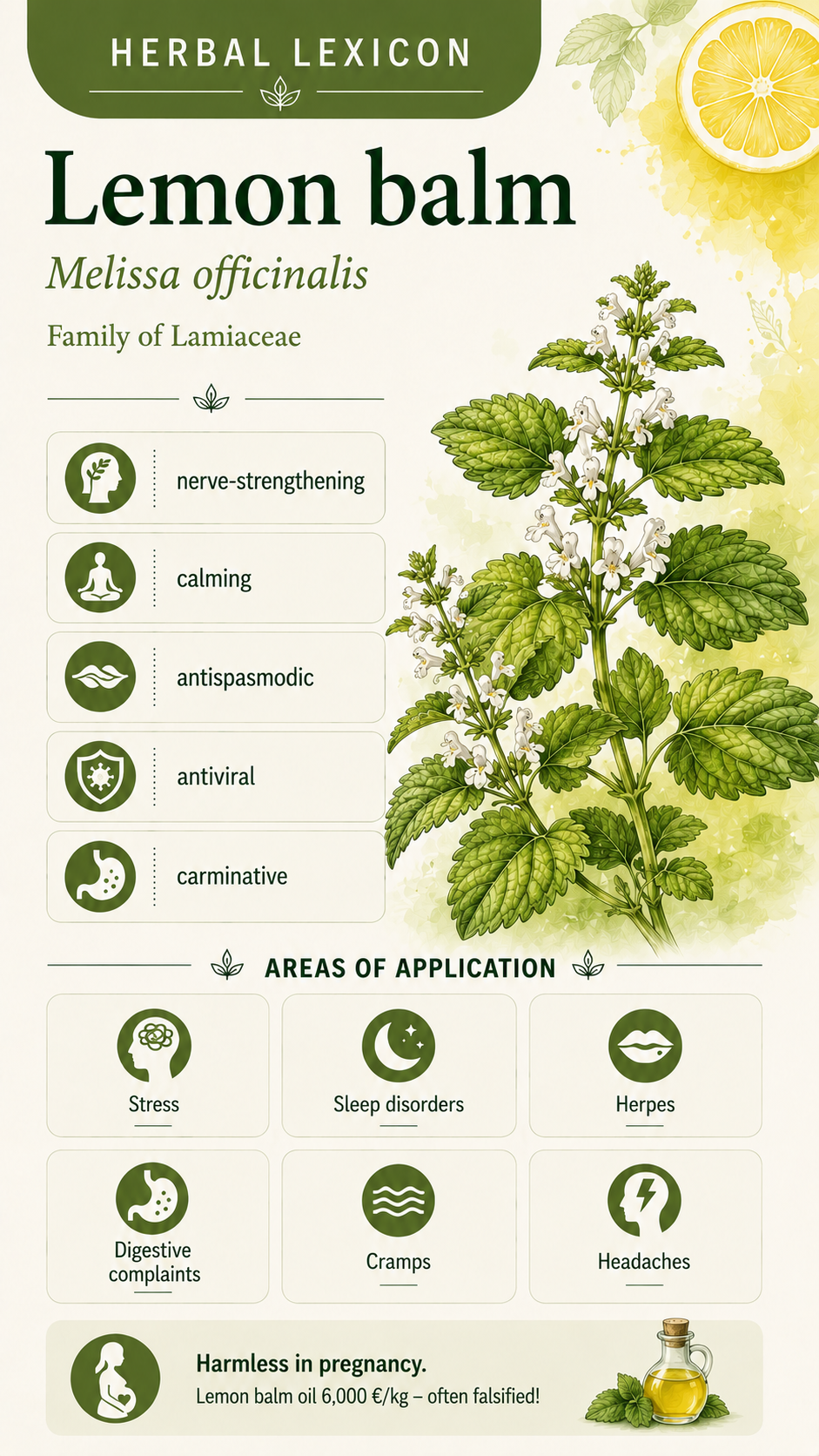

The naturopathic remedy for women – Klosterfrau Lemon Balm Spirit since the 19th century. Essential oil costs approx. €6,000/kg – often adulterated. Antiviral against herpes viruses. Safe to use during pregnancy.
Interesting facts about lemon balm
- Lemon balm essential oil is one of the most expensive essential oils (approx. €6,000/kg)—it is often adulterated with cheaper lemongrass oil.
- In Greek, "melissa" means "bee"—the ancient Greeks cultivated fields of lemon balm as a food source for bees; lemon balm juice was considered an elixir of immortality.
- In initial studies, lemon balm has shown positive effects on Alzheimer's disease when used in aromatherapy: it improves cognitive function by modulating the cholinergic system.
Effects & Properties
Rosmarinic acid (3–4%): Antiviral against herpes simplex virus (HSV-1, HSV-2), herpes zoster, and HPV by inhibiting viral DNA replication. Anti-inflammatory through COX-2 inhibition. Essential oil (citral/geranial + neral): promotes serotonin production by inhibiting serotonin reuptake – calming, sleep-inducing, mood-lifting. Flavonoids (luteolin, apigenin): GABAergic (apigenin is a weak GABA_A receptor modulator) – anxiolytic, muscle relaxant.
Features: nerve-strengthening, calming, antispasmodic, antiviral, carminative, sleep-inducing.
Applications
Lemon balm for stress and nervousness
Chronic stress permanently activates the HPA axis: Cortisol suppresses serotonin synthesis in the raphe nucleus, increases glutamatergic hyperactivity, and reduces GABAergic inhibition—leading to hyperarousal: inner restlessness, jumpiness, and difficulty concentrating. Melissa essential oil inhibits serotonin reuptake: serotonin accumulates, and the calming serotonergic effect on the amygdala and raphe nucleus increases. Flavonoids such as apigenin modulate GABA-A receptors: GABAergic inhibition normalizes, and hyperactivation of the limbic system decreases.
Lemon balm for sleep disorders
Sleep disorders arise from an imbalance between neurotransmitters that promote sleep (serotonin → melatonin, GABA) and those that interfere with sleep (norepinephrine, cortisol). Citral and geranial increase serotonin levels: Serotonin is the precursor to melatonin—higher serotonin levels in the evening lead to increased melatonin production and earlier sleep onset. The GABA-A-modulating effect of flavonoids reduces glutamatergic overactivation. When used in aromatherapy (aroma diffuser), this acts transnasally directly on the limbic system.
Lemon balm for herpes viruses
After the initial infection, herpes simplex viruses remain latent in sensory neurons. They reactivate in cases of immune deficiency or stress, leading to the formation of blisters. Rosmarinic acid inhibits the viral DNA-dependent DNA polymerase, which is essential for viral replication. When applied topically to herpes blisters: lemon balm oil kills viruses directly by damaging their membranes, accelerates healing, and alleviates the neuropathic pain associated with nerve inflammation. For shingles: pain relief through GABAergic nerve stabilization.
Lemon balm for digestive problems
Stress activates the sympathetic nervous system and inhibits the enteric nervous system (ENS): gastric emptying slows down, intestinal peristalsis becomes dysregulated, and glandular secretion decreases—leading to bloating, constipation, or stress-related diarrhea. Lemon balm normalizes the ENS by calming the central nervous system: less sympathetic overactivity means greater ENS autonomy. The flavonoids have a direct spasmolytic effect on the smooth intestinal muscles (calcium channel blockade)—cramps are relieved.
Lemon balm for menstrual cramps
Dysmenorrhea is caused by excessive PGF2α synthesis in the endometrium: PGF2α causes ischemic contraction of the uterine muscles—the resulting lack of oxygen triggers cramping pain. Lemon balm flavonoids (luteolin, apigenin) inhibit COX-2: Less PGF2α means weaker myometrial contractions, improved blood flow, and less pain. The spasmolytic effect of the flavonoids also directly relaxes the myometrium.
Instructions for Use
Regular, long-term use is recommended for nervous tension. Sleep: Evening tea or an aroma lamp.
Pregnancy & Breastfeeding
Completely harmless—in fact, beneficial. The calming effect is said to benefit the unborn child as well.
Plant Profile
- Scientific name: Melissa officinalis L.
- Plant family: Lamiaceae
- Other names: Heartsease, Bee Balm, Lady's Bedstraw
- Flowering period: June through August
- Origin: Eastern Mediterranean
- Toxicity: Non-toxic