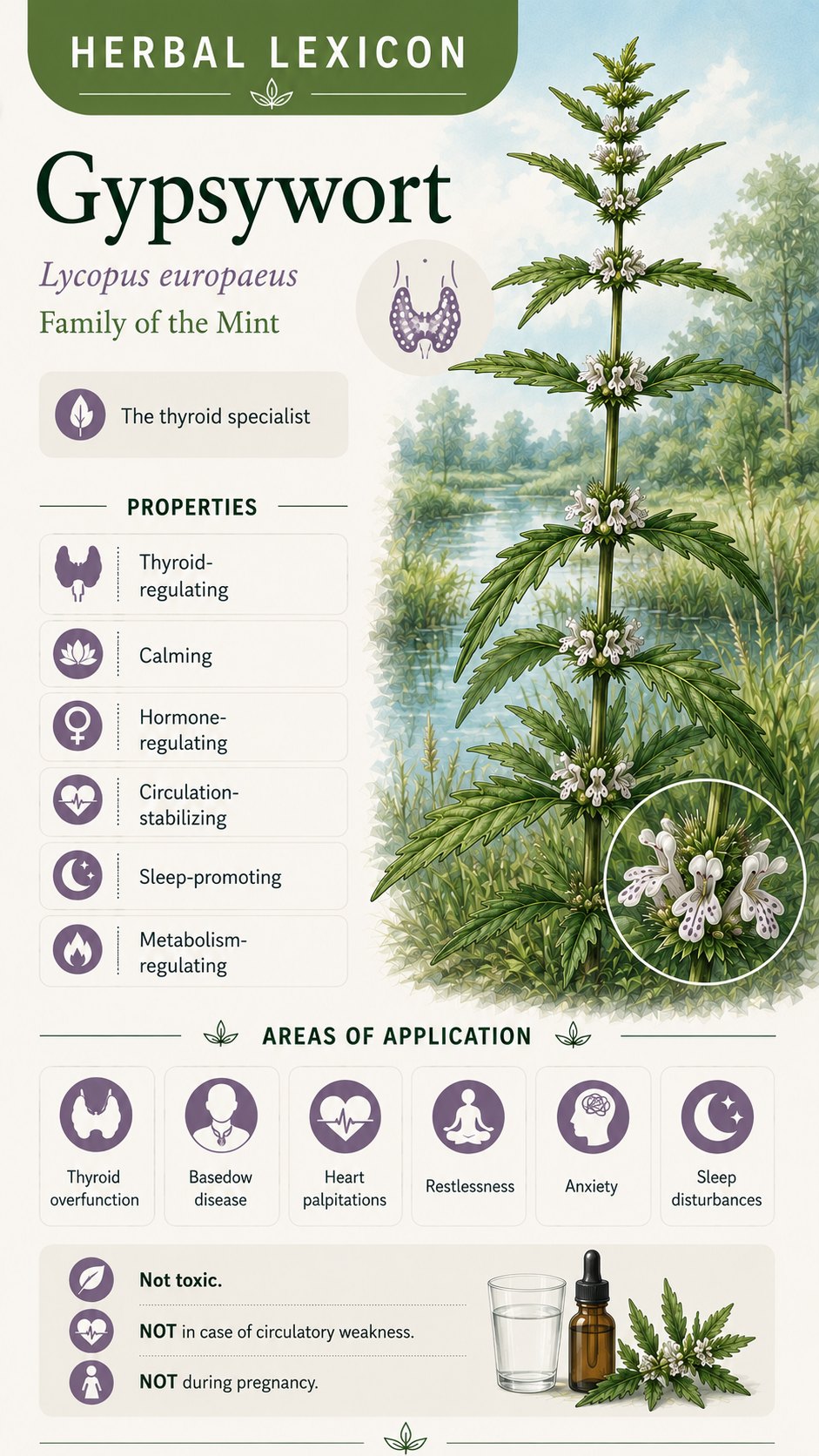

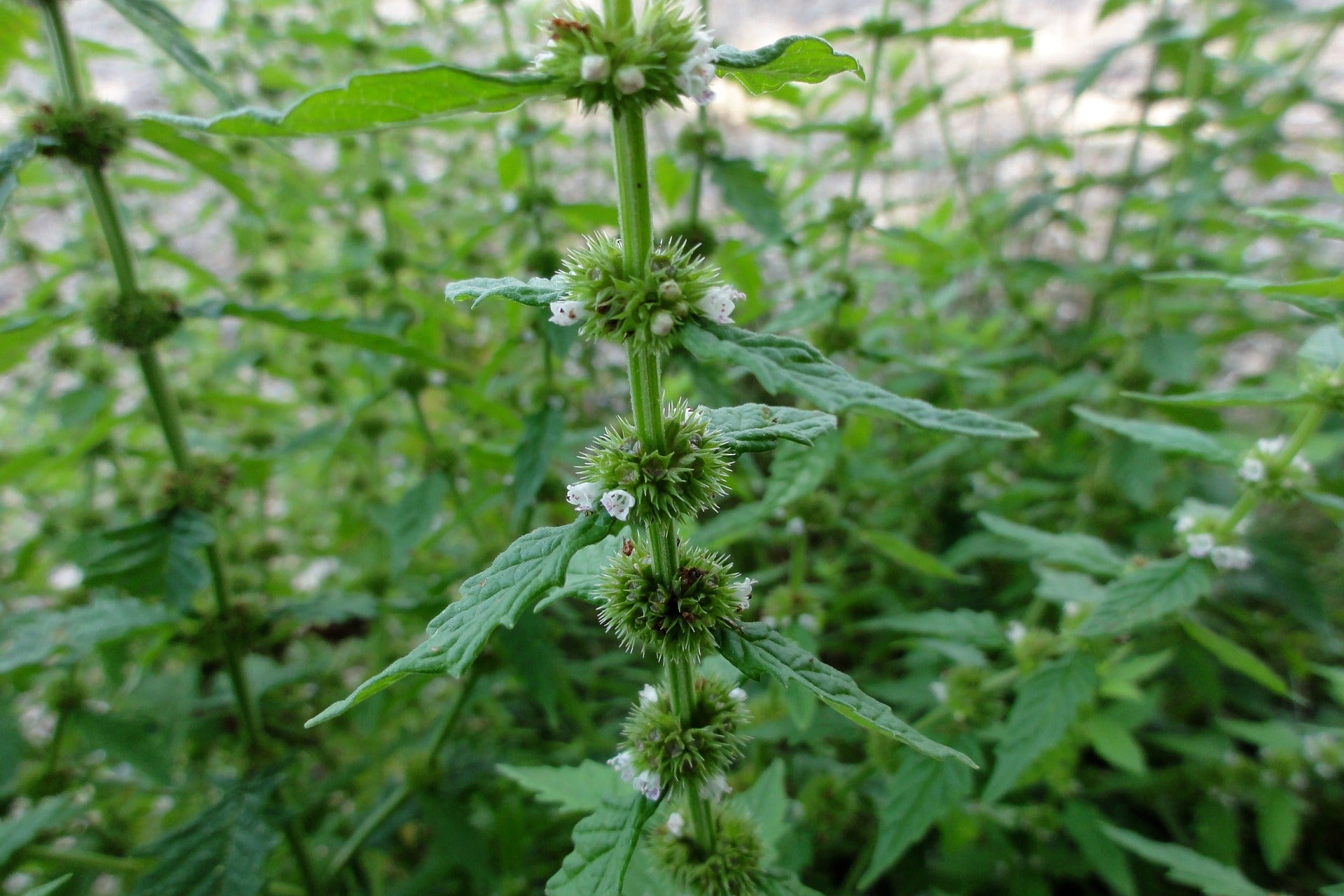
The only medicinal plant that specifically targets the thyroid—Lycopus europaeus inhibits thyroid peroxidase, reduces T3/T4 production, and calms an overstimulated thyroid metabolism. Indicates dampness. NOT recommended for circulatory weakness.
Interesting facts about Wolf's Foot
- Wolfstrapp is a moisture indicator—it grows exclusively in areas with permanently moist soil and thus reliably indicates high groundwater levels.
- Despite its name, wolf's-foot belongs to the mint family (Lamiaceae)—it is related to deadnettle and mint.
- As the only native medicinal plant with a direct effect on thyroid hormone production, wolf's-bane is pharmacologically unique among European wild plants.
Effects & Properties
Gallic acid + tannic acid: competitively inhibit thyroperoxidase—the enzyme that oxidizes iodide into active iodine. Less active iodine means less T3 and T4 production. Pituitary suppression: Lycopus also inhibits TSH-stimulated adenylate cyclase—less TSH signaling means less stimulation of the thyroid. Peripheral T4 conversion: Gallic acid inhibits the peripheral conversion of T4 to T3 in the liver and kidneys.
Features: Thyroid-regulating, calming, hormone-regulating, circulation-stabilizing, sleep-promoting, basal metabolic rate-regulating.
Applications
Dewberry for hyperthyroidism
Hyperthyroidism is caused by autonomous nodules or autoimmune stimulation (Graves’ disease: TSH receptor autoantibodies). In both cases, T3/T4 levels exceed the body’s needs—the basal metabolic rate increases dramatically, heart rate and body temperature rise, and the nervous system becomes overstimulated. Lycopus inhibits thyroid peroxidase and thus directly reduces hormone biosynthesis: Less T3/T4 in the blood means slower cellular respiration, a lower heart rate, and less sympathetic overactivation. The symptoms of hyperthyroidism gradually subside over the course of weeks.
European betony for Graves' disease
Graves' disease: Autoantibodies against the TSH receptor (TRAK) continuously stimulate the thyroid gland. Wolfsbussel does not interfere with the autoimmune process but acts downstream: Inhibition of thyroid peroxidase slows hormone synthesis despite excessive TRAK stimulation. Palpitations, sweating, and weight loss are significantly alleviated by the lower T3/T4 levels. Useful as a complementary therapy alongside thyreostatics.
Motherwort for palpitations caused by hyperthyroidism
T3 binds to myocardial receptors, increases gene expression for beta-1-adrenergic receptors, and heightens the heart’s sensitivity to catecholamines—causing the heart to beat too fast and irregularly. Wolf's-foot lowers T3 levels: With less T3, beta-1 receptor overexpression decreases, cardiac sensitivity normalizes, and the pulse and rhythm slow down.
Lycopus europaeus for sleep disturbances caused by hyperthyroidism
An elevated basal metabolic rate and body temperature prevent the necessary nighttime cooling; an overstimulated nervous system prevents the transition into sleep. Wolf's-foot lowers hormone levels and thus the basal metabolic rate: body temperature normalizes in the evening, and the nervous system shifts into the parasympathetic rest mode. Sleep is achieved, and deep sleep phases become longer.
Instructions for Use
Take the drops 2–3 times a day. As a short course of treatment or for a longer period—depending on the severity of the hyperthyroidism.
Pregnancy & Breastfeeding
DO NOT use—the effect on hormone regulation is unpredictable. Always consult a therapist.
Circulatory insufficiency
NOT for hypotension – Lycopus may further lower blood pressure.
Plant Profile
- Scientific name: European bugle
- Plant family: Lamiaceae
- Other names: Wolfstrapp
- Flowering period: July through September
- Origin: Europe, Asia
- Toxicity: Non-toxic