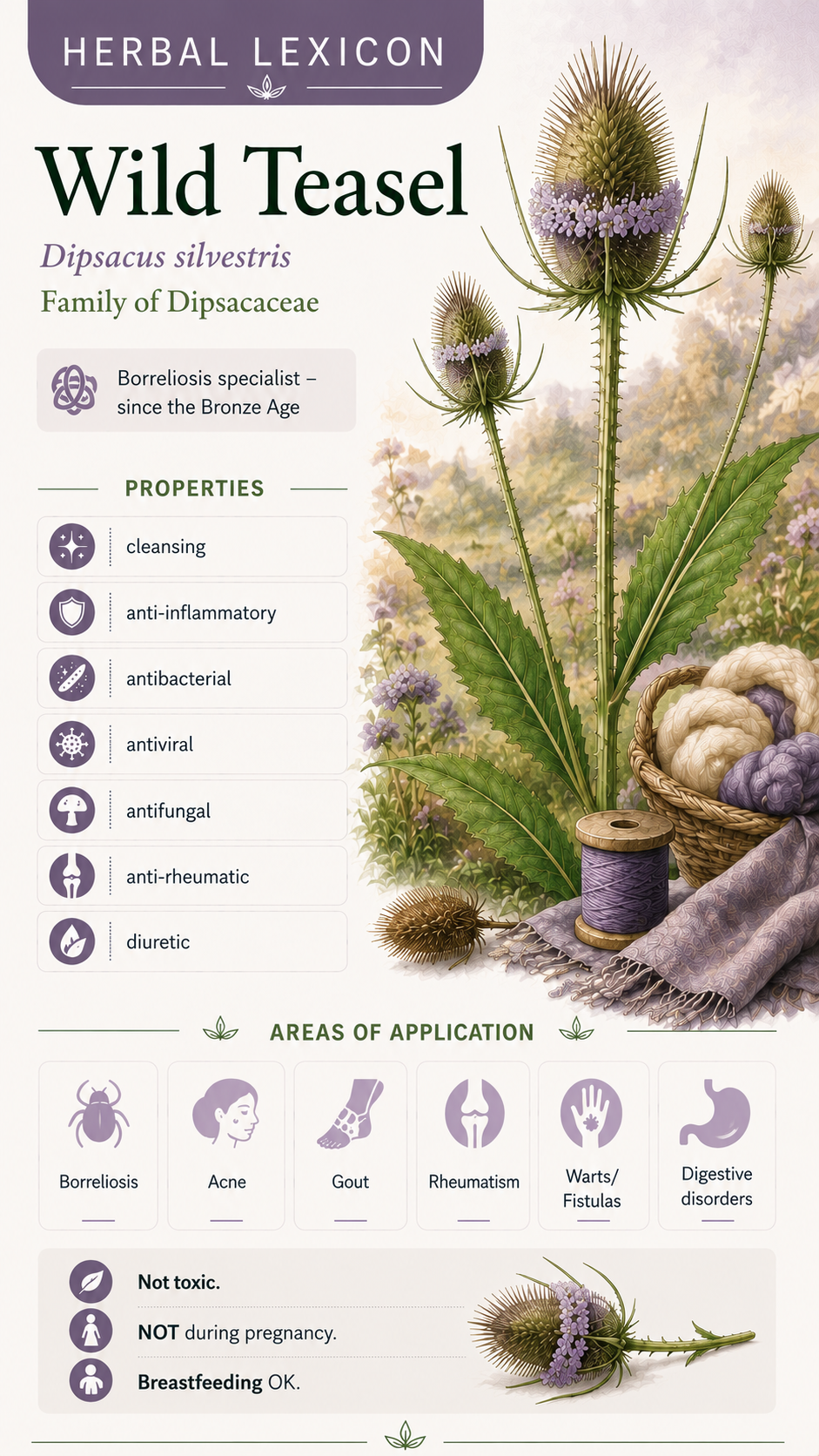

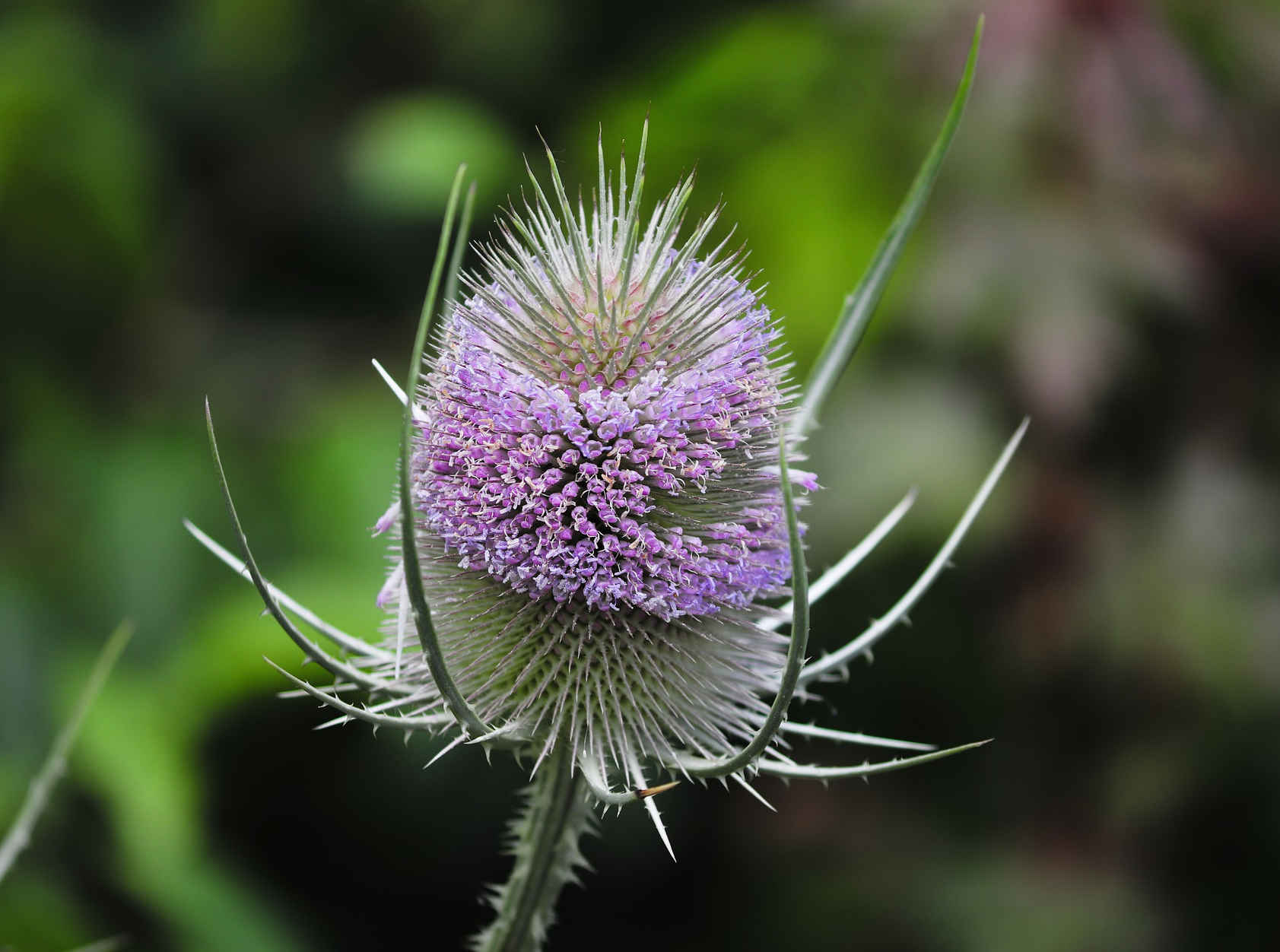
The Bronze Age crop—carding takes its name from it. A specialist in Lyme disease within modern naturopathy. NOT recommended during pregnancy. Safe during breastfeeding.
Interesting facts about wild teasel
- The term "carding" (combing wool) derives directly from the wild teasel—its bristly flower heads have been used since the Bronze Age to comb through and roughen up raw sheep's wool.
- Dipsacus comes from the Greek word *dipsa*, meaning "thirst": The leaves grow together to form rosettes that collect rainwater—small insects drown in these "leaf basins," potentially serving as a source of nutrients (semi-carnivorous behavior).
- In Traditional Chinese Medicine (Xu Duan), milk thistle has been used for centuries to treat bone and joint pain—recent research is also investigating its potential efficacy against hepatitis B.
Effects & Properties
Iridoids (loganin, sweroside) + chlorogenic acid: They activate pattern recognition receptors on immune cells (Toll-like receptors)—this is the innate immune system’s first alarm signal. Macrophages and NK cells are mobilized. It is precisely this cellular immune response that is crucial for combating pathogens that hide inside cells—such as Borrelia bacteria.
Phenols + Tannins: Anti-inflammatory (COX inhibition), antibacterial, antiviral, astringent (wound closure).
bitter compounds: By stimulating the bitter taste receptors on the tongue, it reflexively activates the liver, gallbladder, and all digestive glands—promoting detoxification and cleansing.
Features: Cleansing, anti-inflammatory, antibacterial, antiviral, antirheumatic, detoxifying, astringent.
Applications
Wild teasel and Lyme disease
The bacterium Borrelia burgdorferi is extremely difficult to eliminate after a tick bite: it constantly changes its surface proteins and hides from the immune system in connective tissue, joints, and the central nervous system. The immune system often fails to detect it. In contrast, the iridoids and phenols in wild teasel activate the cellular immune response—specifically macrophages and NK cells, which can track down even hidden pathogens. Empirical evidence from naturopathy shows significant improvement in cases of chronic Lyme disease.
Dipsacus silvestris for acne
Acne is caused by a combination of factors: excessive sebum production (hormone-driven), clogged pores, and inflammation caused by skin bacteria. The bitter compounds in wild cardoon stimulate the liver—improved liver detoxification lowers androgen levels, which overstimulate the sebaceous glands. At the same time, the phenols have a direct antibacterial effect against acne-causing bacteria and an anti-inflammatory effect on inflamed pores.
Wild teasel for gout
Gout occurs when there is too much uric acid in the blood, causing it to form crystals in the joints. These crystals trigger acute inflammation. Wild cardoon acts on both fronts: its bitter compounds stimulate the liver and kidneys to increase uric acid excretion, while its phenols and iridoids directly reduce acute joint inflammation.
Dipsacus silvestris for rheumatism
In rheumatism, the immune system attacks the body’s own joint structures—an autoimmune process. Wild cardoon modulates this process: the iridoids inhibit key inflammatory pathways (NF-κB), the tannins soothe the inflamed synovial membrane, and the detoxifying bitter compounds help eliminate inflammatory byproducts via the liver and kidneys.
Wild teasel for digestive problems
In cases of poor digestion—when stomach acid, bile, and enzymes are insufficient—the cardoon’s bitter-substance mechanism works particularly well: a single drop of tincture placed directly on the tongue reflexively triggers the activation of all digestive glands. This effect is completely lost with tablets, since they bypass the tongue—which is why it should always be taken as drops before a meal.
Instructions for Use
Take the drops directly on the tongue before meals (they have a bitter taste!). The tablets lose their bitter taste. Take as part of a combination supplement several times a day.
Pregnancy & Breastfeeding
Pregnancy: NOT recommended – astringent tannins. Breastfeeding: safe.
Plant Profile
- Scientific name: Dipsacus silvestris Huds.
- Plant family: Teasel family (Dipsacaceae)
- Other names: Card thistle, weaver's thistle
- Flowering period: June through August
- Origin: At home in Europe
- Toxicity: Non-toxic