

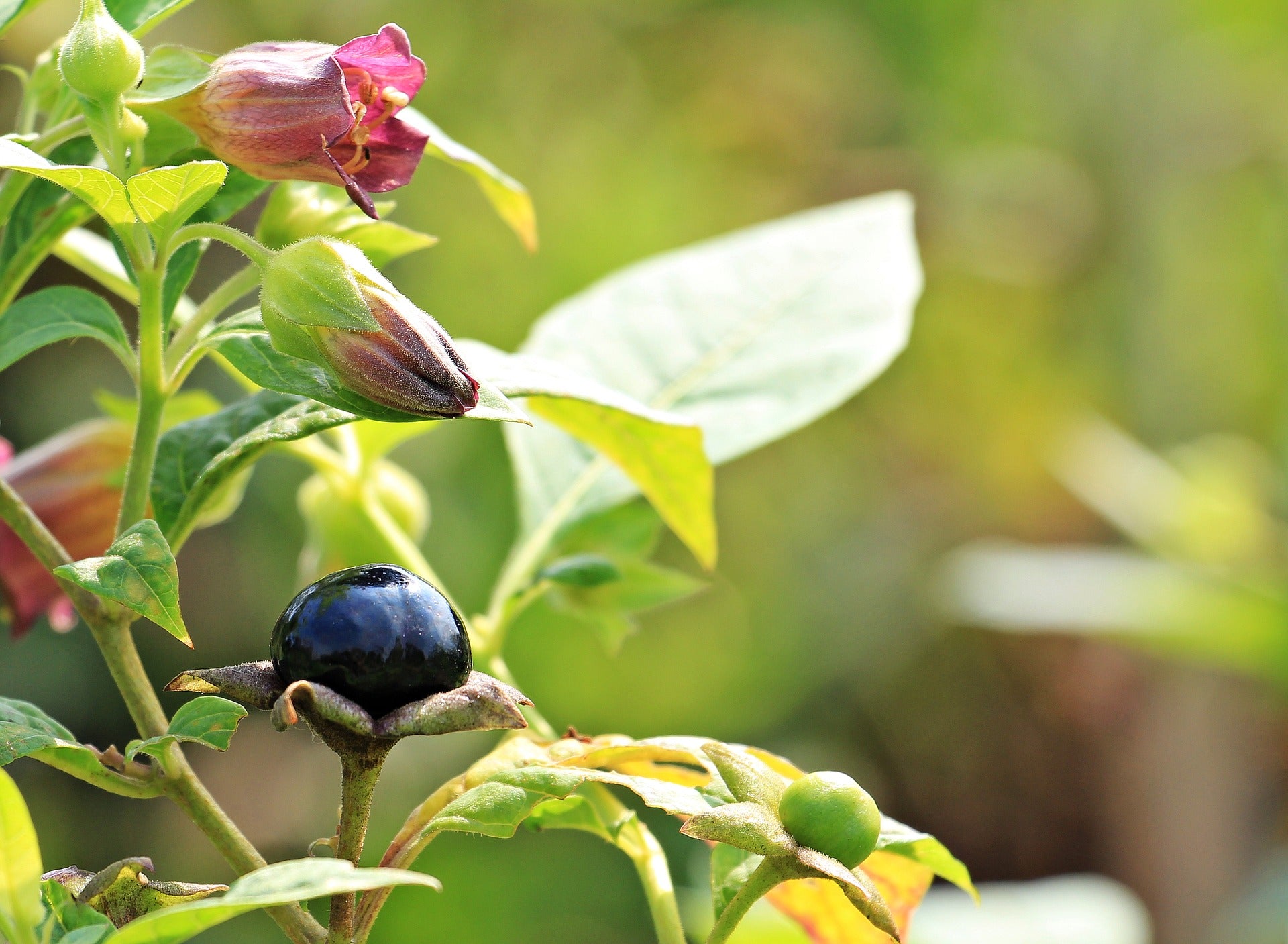
The plant of beautiful Roman women, berserkers, and witches—highly toxic, but a powerful acute remedy when prepared homeopathically or spagyrically. Key symptoms: everything happens suddenly, is bright red, and burning hot.
Interesting facts about belladonna
- Roman women would drip belladonna extract into their eyes—their pupils dilated, making their eyes appear deeper and more expressive. At the same time, their vision became blurry—which made them politically unblackmailable.
- In the morning, after the night, the alkaloid content in the plant is at its highest—as few as 3–5 berries can be fatal to a child.
- Atropine, derived from the belladonna plant, is still used today in ophthalmology—to dilate the pupils before eye examinations.
Effects & Properties
L-hyoscyamine, atropine, scopolamine: These alkaloids block binding sites (muscarinic receptors) in the nervous system through which the parasympathetic nervous system—our "rest and digest" system—sends its signals. In high doses: rapid heartbeat, dilated pupils, dry mouth, agitation. In homeopathic-spagyric preparation: paradoxical healing effect in cases of bright red, hot, suddenly onset conditions.
Features: Anti-inflammatory, antipyretic, antispasmodic, nerve-regulating, pain-relieving.
Only spagyric or homeopathic
Highly toxic. Requires a prescription up to D3; must be purchased at a pharmacy starting at D4. For acute use only—not for long-term treatment. Always consult a therapist.
Applications
Belladonna for flu-like symptoms
With an acute cold, the immune system kicks into high gear: the brain raises the body’s target temperature, heart rate and sweat production increase, and the body is working at full capacity. Belladonna fits this picture perfectly—sudden onset, heat, and flushing. In homeopathic preparation, it calms this excessive reaction: the fever breaks, sweating subsides, and the patient feels immediate relief.
Atropa belladonna for fever
Classic Belladonna fever is unmistakable: the face is bright red, the skin is burning hot and dry, and the head is throbbing. Belladonna provides targeted relief in this condition—it calms the brain’s overactive temperature regulation without completely suppressing the fever’s beneficial immune function. The temperature gradually drops, and the red face returns to normal.
Belladonna for tonsillitis
In cases of acute tonsillitis, the tonsils are bright red, burning hot, and severely swollen—and every swallow is painful. This is the classic Belladonna picture. The active ingredients soothe the inflammation of the mucous membrane: the swelling and redness subside, and swallowing becomes possible again.
Belladonna for stomachaches and cramps
Gastrointestinal colic occurs when the intestines can no longer relax—resulting in persistent, painful cramps. Belladonna has a relaxing effect on the intestinal muscles: the cramps subside, the rhythm returns to normal, and the pain eases. It is particularly effective for cramps caused by nervous tension.
Belladonna for heatstroke
Sunstroke literally overheats the brain—causing a throbbing headache that worsens with movement, nausea, and dizziness. For centuries, Belladonna has been the remedy of choice for this sudden, intense overstimulation of the nervous system: it soothes inflammation of the meninges and alleviates the pressure-pain complex.
Belladonna for acute joint inflammation
An acute gout attack or reactive joint inflammation often presents with Belladonna-like symptoms: the joint is burning hot, bright red, and extremely sensitive to touch. Belladonna draws the heat out of the joint, soothes the inflammation, and quickly reduces the pain.
Instructions for Use
Exclusively spagyric or homeopathic. Only for acute conditions—no long-term medication. Consult a therapist.
Pregnancy & Breastfeeding
Lower potencies (up to D3) should only be used after consulting with the therapist. Higher potencies and spagyric remedies are generally considered safe.
Plant Profile
- Scientific name: Atropa belladonna
- Plant family: Nightshade family (Solanaceae)
- Other names: Wood nightshade, devil's cherry, belladonna
- Flowering season: June through August
- Origin: Europe and Western Asia
- Toxicity: Highly toxic
