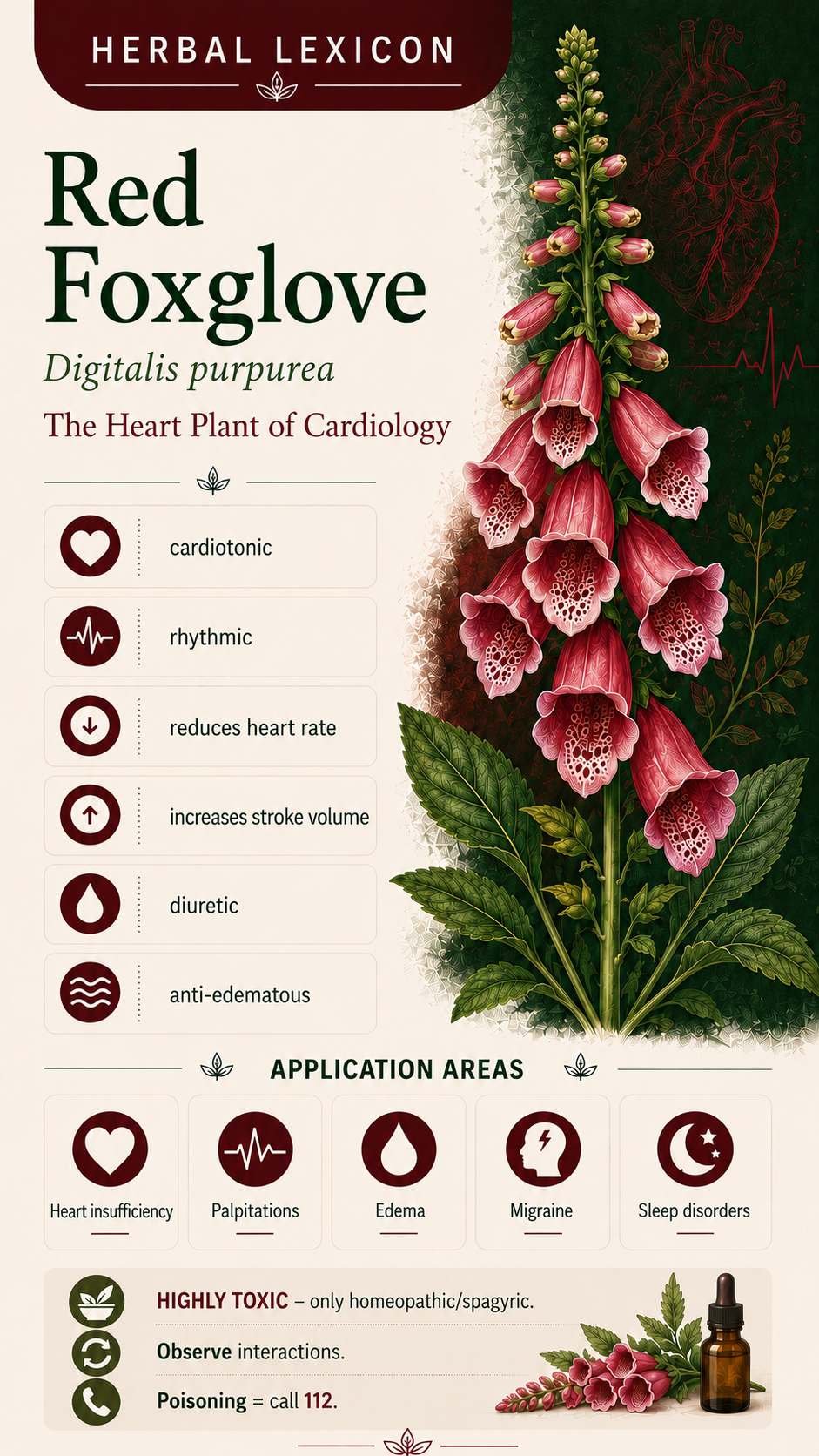


The cornerstone of modern cardiology—discovered in 1785, now a standard treatment. Highly toxic: use only in homeopathic or spagyric forms!
Interesting facts about red foxglove
- Most widespread in Germany: the Harz Mountains and the Thuringian Forest.
- Fox herb: It is said that evil fairies gave foxes the ability to move silently.
- 1785: First documented use for treating heart-related edema in England.
Effects & Properties
Cardiac glycosides (Digoxin, digitoxin): inhibit Na/K-ATPase in heart muscle cells. The intracellular calcium concentration rises—the heart beats stronger, slower, and more consistent. Narrow therapeutic index—even small differences in dosage can mean the difference between successful treatment and dangerous poisoning. Accumulation with long-term use!
Features: heart-strengthening, rhythm-regulating, heart rate-lowering, stroke volume-increasing, diuretic.
Only homeopathic or spagyric
Highly toxic – in naturopathy, used exclusively in homeopathic or spagyric preparations. Allopathic preparations: only under medical supervision to monitor blood levels.
Applications
Foxglove for Heart Failure
In heart failure, the heart muscle loses its pumping power, leading to edema, shortness of breath, and fatigue. The cardiac glycosides in foxglove inhibit Na/K-ATPase, thereby increasing the intracellular calcium concentration in the heart muscle cells. The heart beats more forcefully—pumping capacity increases, edema subsides, and the physical consequences of heart failure abate.
Digitalis for Atrial Fibrillation
In atrial fibrillation, the atria send chaotic electrical signals—causing the heart rhythm to become irregular. Cardiac glycosides slow down the conduction in the AV node, giving the heart time to filter out the chaotic atrial signals. The result: the heart rhythm becomes more regular, and the heart rate drops to a more controlled level.
Foxglove for Edema
Heart-related edema occurs when a weakened heart can no longer pump enough blood into the body’s circulatory system—causing fluid to accumulate in the legs and lungs. As cardiac glycosides improve the heart’s pumping function, blood circulates more efficiently again, the kidneys can excrete more fluid, and the edema subsides.
Digitalis for Migraines
Migraines caused by heart failure occur when the weakened heart can no longer supply the brain with sufficient blood. As cardiac output improves, blood flow to the brain returns to normal and the heart-related headaches disappear.
Foxglove for sleep disorders
An irregular, too-fast, or too-weak heartbeat disrupts sleep due to the noticeable pounding sensation in the chest. Cardiac glycosides regulate heart rate and rhythm: The heart beats calmly and steadily—the pounding sensation disappears, and sleep improves.
Instructions for Use
Homeopathic remedies or spagyric medicine (naturopathic) only. Allopathic: Medical monitoring of blood levels is mandatory.
Pregnancy & Breastfeeding
Only to be performed by experienced therapists. Generally contraindicated without therapeutic supervision.
Poisoning – Emergency!
Call 112 immediately in cases of: color vision disturbances (everything appears yellow-green), nausea, cramps, hallucinations, or heart rhythm disturbances.
Plant Profile
- Scientific name: Foxglove
- Plant family: Plantain family (Plantaginaceae)
- Other names: Fingerwort, Foxwort
- Flowering period: June through August
- Origin: Native to (Europe)
- Toxicity: Highly toxic