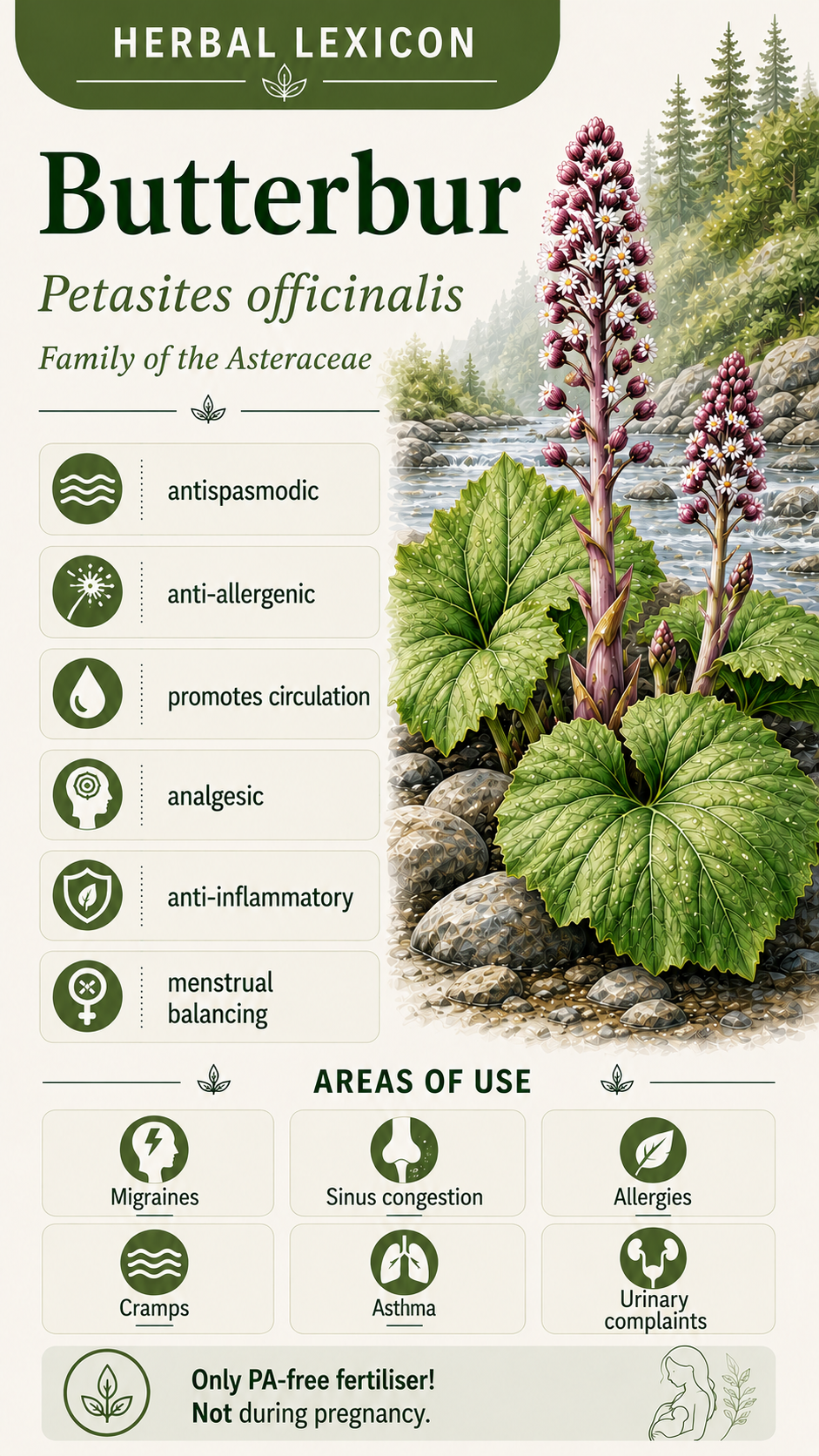

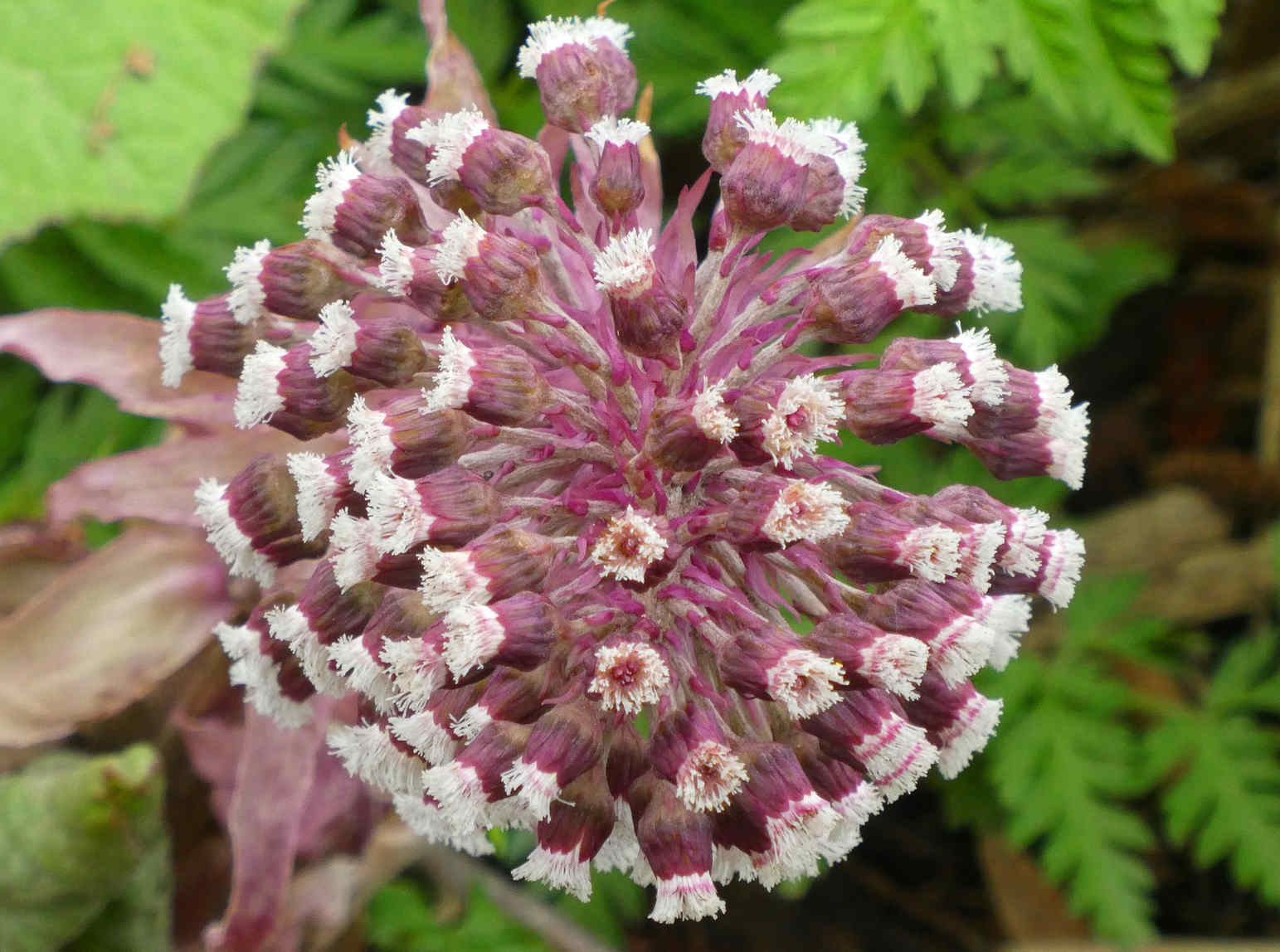
A medicinal plant dating back 4,000 years—now proven effective primarily for migraines and hay fever. Important: Use only PA-free over-the-counter medications!
Interesting facts about Pestwurz
- It has the name of the plague—but is completely ineffective against Yersinia pestis.
- Found in 4,000-year-old excavations—possibly used as toilet paper.
- Stabilizes riverbanks in alluvial areas with its enormous leaves.
Effects & Properties
Sesquiterpenes (Petasine, Petasole): relax the smooth muscles in hollow organs, blood vessels, and the bronchi. Antiallergic: intervenes in the inflammatory cascade earlier than antihistamines—and without the annoying drowsiness as a side effect.
Features: antispasmodic, anti-allergic, circulatory-stimulating, analgesic, anti-inflammatory.
Applications
Butterbur for Migraines
Migraines are caused by spasms and inflammatory irritation of the blood vessels in the brain, as well as by muscle tension in the neck. The sesquiterpenes in butterbur relax the smooth muscles of the blood vessels, improve blood flow, and relieve vascular spasms. Several clinical studies demonstrate that PA-free butterbur-based finished pharmaceutical products significantly reduce the frequency of migraine attacks—comparable to some migraine prophylactics.
Butterbur for hay fever
In hay fever, the nasal mucous membranes swell upon contact with pollen and react by releasing excessive amounts of histamine. Butterbur intervenes in the inflammatory cascade earlier than traditional antihistamines and normalizes blood flow in the mucous membranes. The key practical advantage: Butterbur does not cause drowsiness—a common problem with first-generation antihistamines.
Butterbur as a muscle relaxant
The smooth muscles in hollow organs—the gallbladder, uterus, and bladder—are prone to spasms during times of stress and in the presence of inflammatory processes. The sesquiterpenes in butterbur specifically relax these smooth muscles, providing relief from gallbladder colic, menstrual cramps, and bladder spasms. Butterbur is therefore a versatile muscle relaxant for internal organs.
Butterbur for urinary tract problems
Urinary colic and cramps associated with the passage of kidney stones are caused by spastic contractions of the ureteral muscles. Butcher’s broom relaxes the urogenital muscles, facilitates the passage of stones, and relieves cramps. In cases of inflammatory urinary tract symptoms, its anti-inflammatory properties provide additional relief.
Instructions for Use
ONLY PA-free finished pharmaceutical products! Do not prepare your own mixture. Take 3 times a day as a course of treatment. Stop use immediately if liver symptoms occur.
Pregnancy & Breastfeeding
Contraindicated – affects blood circulation and muscle tone.
Allergy to composite flowers
Caution – Consult a doctor or alternative practitioner.
Plant Profile
- Scientific name: Butterbur
- Plant family: Asteraceae
- Other names: Red butterbur, brook butterbur
- Flowering period: February through April
- Origin: Europe
- Toxicity: Toxic (only PA-free finished pharmaceutical products!)