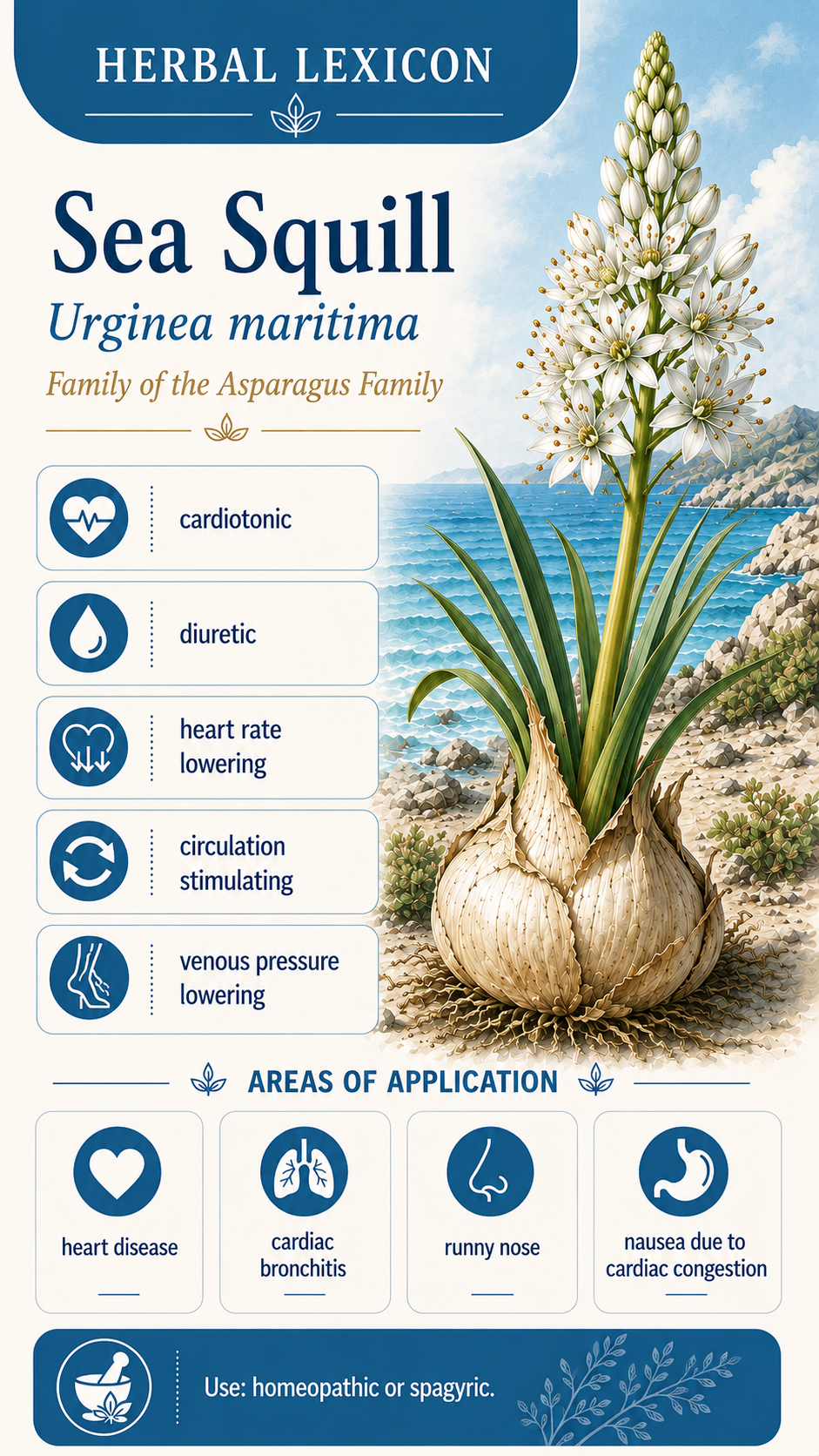


Once used as a remedy for dropsy and as rat poison—today indispensable as a homeopathic remedy for heart-related congestion.
Interesting facts about sea onion
- Bulb weighing up to 3 kg, with most of it above ground.
- It was not until the 20th century that it was discovered as a heart medication for humans.
- Medicinal plant: the scales of the white onion.
Effects & Properties
Scillaren glycosides: similar to foxglove – strengthens the heart, lowers heart rate. Compared to digitalis, scillarin glycosides have a slightly broader therapeutic range and a lower tendency to accumulate in the body. Toxic in its pure form – only homeopathic or spagyric.
Features: heart-strengthening, diuretic, reduces heart rate, reduces venous pressure.
Applications
Urginea maritima for heart conditions
In heart failure, the heart muscle loses its strength—it can no longer pump blood effectively into the body’s circulatory system. This leads to fluid retention: in the legs (edema), in the lungs (congestive bronchitis), and in the abdominal organs (nausea). Scillaren glycosides directly strengthen the heart muscle: pumping capacity increases, congestion resolves, and organ function returns to normal.
Sea onion for bronchitis
In left heart failure, the heart does not pump enough blood into the systemic circulation. Blood backs up into the lungs—the pulmonary vessels become overloaded, and pulmonary edema develops. The stagnant blood causes mucus to build up in the lungs, leading to chronic congestive bronchitis. Sea onion strengthens the heart muscle and improves pumping capacity—the congestion in the lungs resolves, and the bronchitis disappears.
Urginea maritima for the common cold
Heart-related congestion affects not only major organs but also the microcirculation in the mucous membranes. Poorly perfused nasal mucous membranes swell and become congested. Sea onion improves microcirculation by strengthening the heart: the mucous membranes receive better blood flow, the swelling subsides, and the nose clears up again.
Sea onion for nausea
Heart-related congestion in the abdomen—including portal vein congestion and congestion of the abdominal organs—can cause persistent nausea. The abdominal organs function under conditions of reduced blood flow and congestive pressure. Sea onion alleviates abdominal congestion by strengthening the heart: blood flow returns to normal, the organs resume proper function, and the nausea subsides.
Instructions for Use
Homeopathic or spagyric, chronic over extended periods, on a regular basis.
Pregnancy & Breastfeeding
This is possible in consultation with an experienced therapist.
Important: Only homeopathic or spagyric
Toxic in its pure form—never use as a raw drug.
Plant Profile
- Scientific name: Urginea maritima
- Plant family: Asparagus family (Asparagaceae)
- Flowering period: August through October
- Origin: Mediterranean region
- Toxicity: Toxic – only in homeopathic/spagyric forms