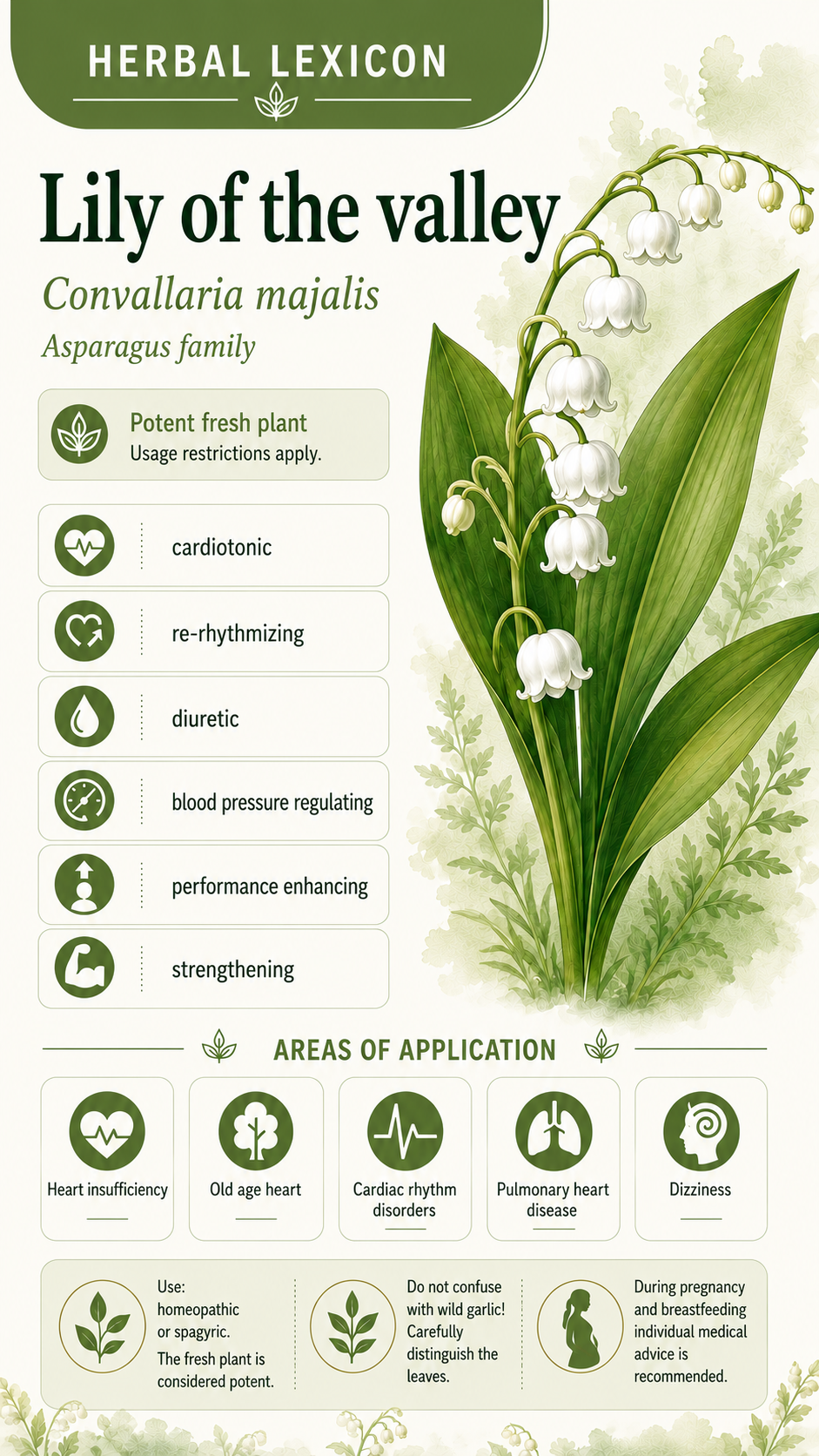

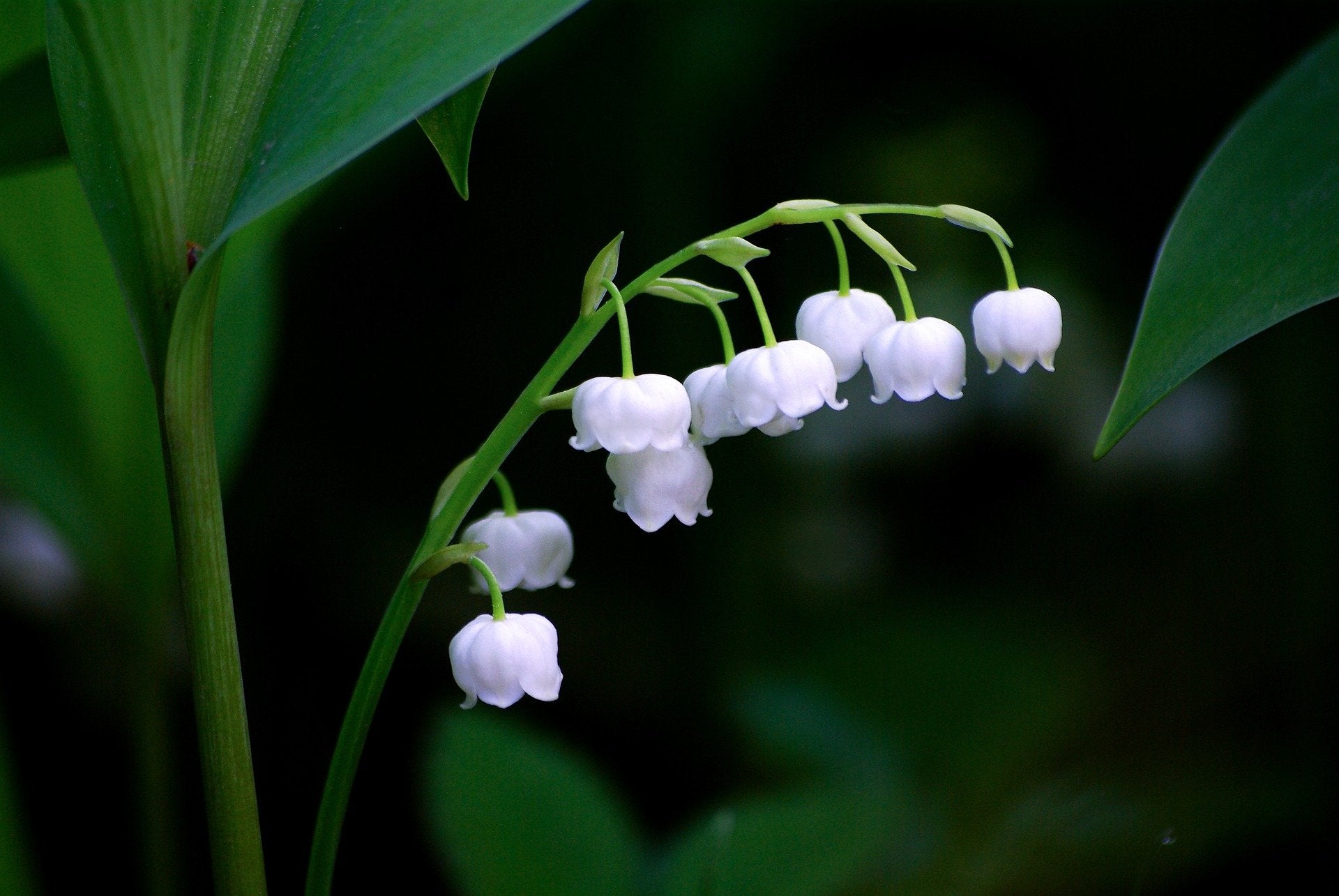
Elfin beauty and deadly poison in one—indispensable in homeopathy for the exhausted heart.
Interesting facts about lily of the valley
- Risk of mistaking it for wild garlic – deadly!
- A plant associated with the Virgin Mary in Christian iconography (featuring a rose and a lily).
- Freddy Mercury: "Lily of the Valley" (Queen).
Effects & Properties
38 cardiac glycosides: Convallatoxin, Convallatoxol, Convalloside – related to Digitalis. Strengthens the heart muscle and restores a normal heart rhythm. Lily of the valley also has a emotional dimension: It is used to treat heart problems caused by prolonged emotional stress.
Features: heart-strengthening, rhythm-restoring, diuretic, blood pressure-regulating, energy-boosting.
Applications
Lily of the Valley and Heart Failure
In heart failure, the heart muscle is no longer able to pump blood effectively throughout the body, leading to fatigue, shortness of breath, and edema. The cardiac glycosides in lily of the valley strengthen the heart muscle: the heart beats more forcefully and pumping capacity increases. Edema subsides, shortness of breath eases, and quality of life improves.
Lily of the Valley for functional heart problems
Functional heart problems with no organic cause are often triggered by emotional stress—deep-seated sadness, loss, or persistent exhaustion can take a toll on the heart. Convallaria is used to treat heart problems caused by emotional stress. It strengthens the heart on both a physical and emotional level.
Lily of the Valley for Stress Responses
Chronic stress causes a constant release of stress hormones—cortisol and adrenaline—which directly strain the heart muscle. The heart, exhausted by these stress hormones, loses strength and rhythm. Convallaria strengthens the exhausted heart muscle and restores its ability to cope with stress.
Lily of the Valley for the aging heart
As the heart ages, its pumping power gradually declines—the heart muscle becomes stiffer, and the electrical coordination of the heartbeat becomes less precise. Convallaria helps the aging heart beat strongly and regularly again: edema subsides, dizziness and weakness diminish, and a sense of vitality returns.
Lily of the valley for heart arrhythmias
Heart arrhythmias are caused by a disruption in the electrical coordination of the heartbeat. The 38 cardiac glycosides found in lily of the valley help restore a normal heart rhythm by affecting the ion channels in heart muscle cells. The heartbeat becomes more regular, and episodes of palpitations and irregular pulses are reduced.
Lily of the Valley (Convallaria majalis) for cor pulmonale
In cor pulmonale, the right side of the heart is chronically overloaded due to pulmonary hypertension and enlarges as a compensatory response. Convallaria strengthens the right side of the heart and improves its pumping capacity: the pulmonary hypertension may subside, and the compensatory enlargement of the heart may return to normal.
Lily of the valley for dizziness
Dizziness is often caused by insufficient blood flow to the vestibular system in the inner ear or brainstem—the weakened heart is not pumping enough blood to the upper body. Convallaria improves cardiac output and thus blood flow to the brain. Blood pressure stabilizes, blood flow to the vestibular system improves, and the dizziness subsides.
Instructions for Use
Only homeopathic or spagyric. Several times a day. Always consult with your therapist first.
Pregnancy & Breastfeeding
Do not take—cardiac glycosides may affect the fetal heart.
HIGHLY TOXIC – Don't confuse it with wild garlic!
Even small amounts can lead to cardiac arrest. Never use it in its raw form. Only use it as a prepared product. When harvesting wild garlic: the smell of garlic when crushed is a sure sign of its identity.
Plant Profile
- Scientific name: Lily of the Valley
- Plant family: Asparagus family (Asparagaceae)
- Other names: Maieriesli
- Flowering period: May through June
- Origin: Native to (Europe)
- Toxicity: Highly toxic – for homeopathic/spagyric use only