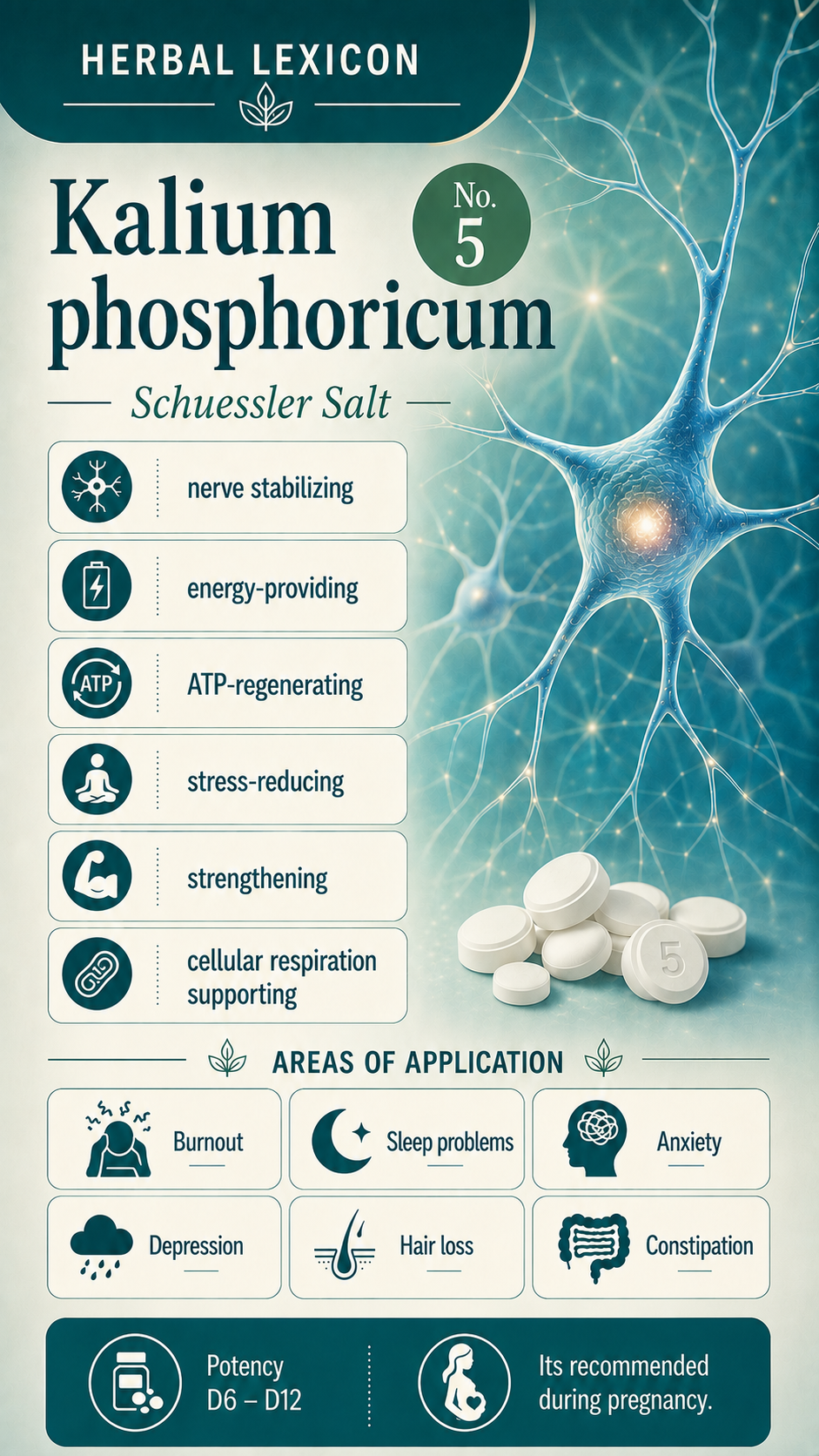


The salt of the nerves – Potassium phosphoricum is, alongside No. 7, the most important Schüssler salt for the central nervous system and energy metabolism.
Interesting facts about Potassium Phosphate
- Food additive E340.
- Widely used in the manufacture of laundry detergent.
- Dialysis patients: Potassium is a critical screening parameter.
Effects & Properties
Potassium: regulates nerve impulses and muscle activity – without sufficient potassium, nerve cells cannot send or receive signals properly. phosphate: regenerates ATP, the cell's energy source. Together, they restore energy balance at the cellular level—giving the nervous system its fuel back.
Features: calms the nerves, boosts energy, regenerates ATP, reduces stress.
Storage Locations & Deficiency Symptoms
Stored in the nerves, brain, muscles, and blood. Symptoms of deficiency:
- Burnout, exhaustion, depression, sleep disorders
- Nervous diarrhea, irritable stomach, anxiety
- Alopecia areata, atopic dermatitis, tics
Applications
Potassium Phosphate for Sleep Problems
Sleep problems caused by stress occur when the overstimulated nervous system cannot wind down in the evening—nerve cells continue to fire, and thoughts race. Potassium regulates nerve impulses and resets the overstimulated system to normal levels. The nervous system winds down, thoughts calm, and sleep returns.
Potassium phosphate for anxiety
Anxiety arises when nerve cells remain in a state of constant overstimulation—the threshold for alarm signals drops, and even the slightest stimulus triggers an anxiety response. Potassium phosphate reduces nerve potentials and raises the threshold at which nerve cells send alarm signals. Tension eases, and the anxiety loses its intensity.
Potassium Phosphate for Healthy Hair
Alopecia areata is often stress-induced—cortisol damages hair follicles and inhibits hair growth. Kalium phosphoricum reduces stress levels in the nervous system and, as a result, lowers cortisol levels. As stress subsides, the hair follicles recover and hair growth resumes.
Potassium phosphate for constipation
Nervous constipation occurs when chronic stress causes the intestinal muscles to spasm—the intestines contract and peristalsis comes to a halt. Potassium phosphate relieves the stress-induced tension in the digestive muscles. The intestines relax, peristalsis resumes, and the constipation resolves.
Instructions for Use
During stressful periods 1–3 times a day as tablets, drops, or ointment.
Pregnancy & Breastfeeding
Safe to use—and even explicitly recommended for stress during pregnancy.
Profile
- Content: Potassium phosphate
- Description: Salt of the nerves
- Distribution: Nerves, brain, muscles, blood
- Schüssler No.: 5
- Typical potency: D6–D12