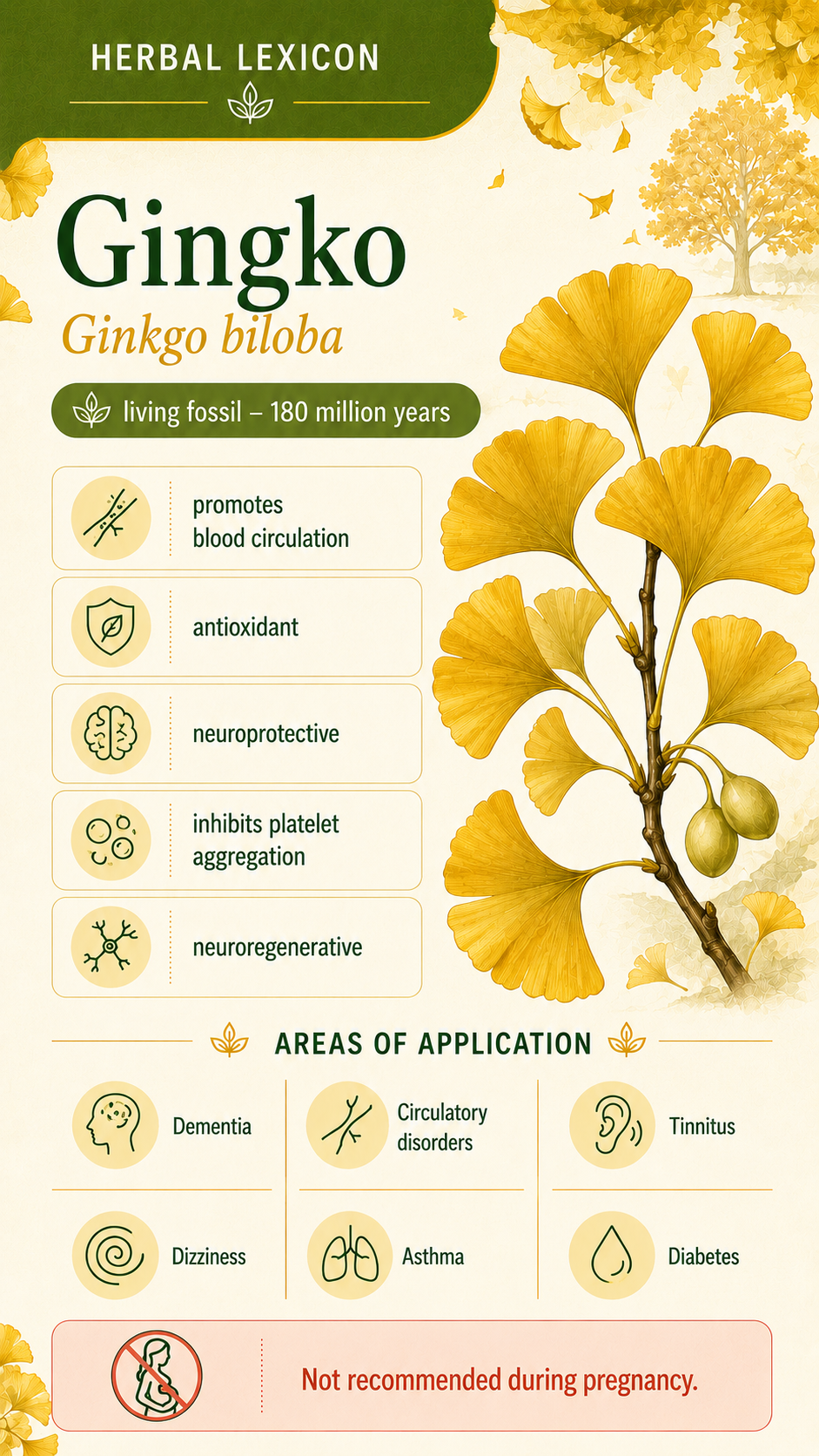


A living fossil for 180 million years—and one of the most extensively studied medicinal plants in the world.
Interesting facts about the ginkgo tree
- Native to our region 180 million years ago—it survived dinosaurs, ice ages, and mass extinctions.
- The fruit smells of butyric acid—which is why only male trees are often planted.
- Ginkgo trees can live for over 1,000 years—some in China are over 3,000 years old.
Effects & Properties
Flavonoids: antioxidant, inhibit platelet-activating factor (PAF)—a key enzyme involved in inflammation and vascular damage. isoprenoids: improve microcirculation in small blood vessels. The result: better oxygen supply to the brain and nerves, and less inflammation in small blood vessels. Clinically proven in numerous studies.
Features: promotes blood circulation, antioxidant, neuroprotective, neuroregenerative, antiplatelet.
Applications
Ginkgo biloba for circulatory disorders
Circulatory disorders occur when microvessels become calcified or inflamed and can no longer transport sufficient blood. Clinical studies confirm the effectiveness of ginkgo in treating tinnitus caused by poor circulation, intermittent claudication, and general microcirculatory disorders. Isoprenoids improve blood flow and the permeability of blood vessel walls.
Ginkgo for Dementia
In dementia, the brain progressively loses neurons—the supply of oxygen and nutrients decreases, and nerve cells die off. Ginkgo improves microcirculation in the brain, increases the oxygen supply to nerve cells, and, thanks to its antioxidant flavonoids, inhibits the free radicals that damage nerve cells. Studies show that it slows the progression of dementia and improves cognitive function.
Ginkgo biloba for asthma
In asthma, the inflamed bronchial mucosa produces excessive mucus, which narrows the airways. Platelet-activating factor (PAF) plays a key role in mucus production. Ginkgo inhibits PAF through its flavonoids—mucus production decreases, the bronchi can dilate, and breathing improves.
Ginkgo for balance problems
The inner ear is particularly sensitive to poor blood flow—even a slight reduction in blood flow can lead to tinnitus, dizziness, and balance problems. Ginkgo specifically improves microcirculation and nutrient supply to the inner ear and helps combat micro-inflammation. Clinical studies have demonstrated its effectiveness in treating tinnitus and stress-related balance problems.
Ginkgo biloba for diabetes
Diabetes damages small blood vessels due to persistently elevated blood sugar levels, leading to diabetic retinopathy, neuropathy, and nephropathy. Ginkgo has antithrombotic and anti-inflammatory effects on these small vessels, protecting them from the damage caused by high blood sugar. Microcirculation improves, and the progression of diabetic complications slows down.
Ginkgo for dizziness
Dizziness is often caused by poor blood flow to the inner ear or brainstem—the vestibular system does not receive enough oxygen and nutrients. Ginkgo specifically improves microcirculation and nutrient supply in these areas. Dizziness subsides, and spatial orientation improves.
Instructions for Use
A finished pharmaceutical product containing standardized ginkgo extract. Discontinue use if hypersensitivity occurs.
Pregnancy & Breastfeeding
Do not take during pregnancy – Accumulation of the toxin in the placenta has been observed. No abnormalities have been reported to date in breastfeeding women.
Plant Profile
- Scientific name: Ginkgo biloba
- Plant family: Ginkgo family (Ginkgoaceae)
- Other names: Fan-leaved tree, maidenhair tree
- Flowering period: March through April
- Origin: Asia
- Toxicity: Non-toxic