

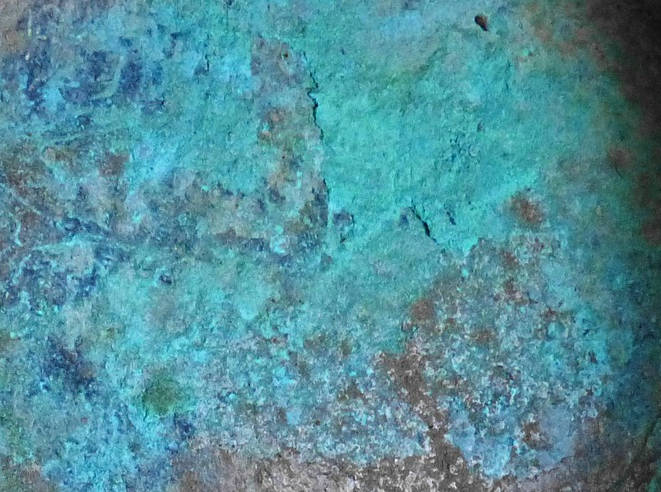
Cuprum sulfuricum has been in use for centuries and is now used exclusively in highly diluted, homeopathic, or spagyric forms. Its main areas of application are conditions involving spasms and microbial infections.
Interesting Facts About Cuprum Sulfuricum
- For centuries, it was a standard treatment for psychotic tendencies under the name Vitriol.
- It occurs in nature as anhydrous chalcocyanite or in hydrated forms such as chalcanthite, bonattite, and poitevenite.
- Pope Alexander VI is said to have ravaged Castel Sant'Angelo in Rome while suffering from vitriol poisoning.
- It is mainly used industrially in the production of copper-based paints, in New Year's Eve fireworks to produce a green flame, and in electroplating for copper plating.
Effects & Properties
Antispasmodic: The involuntary muscles relax, allowing the body to regulate itself more effectively at the cellular level; intense cramps subside or disappear completely. Antimicrobial: Bacteria and fungi are sensitive to copper, so skin infections subside and the skin can regenerate. Supports Kidney Health: Strengthens kidney energy, which regulates body temperature, sleep patterns, and blood circulation in the extremities. Activates iron metabolism: Copper helps the body make iron available for incorporation into red blood cells.
Features: antispasmodic, antimicrobial, kidney-supporting, relaxing, sleep-promoting, metabolism-boosting.
Benefits for the Body and Mind
In naturopathy, Cuprum sulfuricum is considered the substance of Venus and is associated with kidney energy. The focus is on issues related to cramps, mental and physical tension, and a lack of femininity and lightness in the system. Copper supports important metabolic processes in the body and has a relaxing effect on both voluntary and involuntary muscles—making it a top contender for treating stress-related symptoms.
Areas of Application
Cuprum sulfuricum for cramps and emotional tension
In naturopathy, copper is considered the metal of Venus. Cuprum sulfuricum has pronounced antispasmodic properties—it relaxes both voluntary and involuntary muscles, and alleviates colic and muscle cramps. Since cramps are often of psychological origin and are accompanied by inner tension, Cuprum sulfuricum can be used as an adjunct treatment for stress-related symptoms to restore a sense of ease to the system.
Copper Sulfate for Cold Extremities
In traditional Chinese medicine, copper is associated with the kidney-bladder meridian, which distributes life energy throughout the body, grounds the body, and keeps the hands and feet warm. Cuprum sulfuricum strengthens this meridian and the kidney—a cardinal organ—allowing life energy to circulate more effectively throughout the body and stimulating peripheral blood circulation.
Cuprum sulfuricum for skin infections
Bacteria and fungi are sensitive to copper and are reliably weakened by its antimicrobial effect. Cuprum sulfuricum is therefore used topically for infectious skin conditions to reduce the pathogen load and support wound healing in the affected skin areas.
Cuprum sulfuricum for gastrointestinal cramps
Colic and cramping in the digestive tract respond well to the antispasmodic effect of Cuprum sulfuricum. The smooth muscles of the intestine relax, pain and cramping subside, and the intestine’s natural rhythm of movement can be restored.
Cuprum sulfuricum and Iron Metabolism
In naturopathy, copper and iron form an archaic pair: copper represents the principle of femininity, while iron represents the principle of masculinity. If there is sufficient iron but too few red blood cells are still being produced, a copper deficiency may be the cause—copper is needed for the enzymatic process that makes iron available for blood formation. Cuprum sulfuricum is therefore considered as an adjunct treatment in this scenario.
Cuprum sulfuricum for a spasmodic cough
A spasmodic cough at night—such as a dry cough or asthma-like symptoms—can be relieved by the antispasmodic effect of Cuprum sulfuricum on the smooth bronchial muscles. The airways relax, and coughing fits become less frequent and less severe.
Instructions for Use
Starting at D6, in homeopathic form or as a spagyric essence, usually 3 to 5 times a day in acute conditions as part of a complex mixture. Dosage forms include powder, drops, or tablets. It should be used as a course of treatment; long-term use is not recommended.
Pregnancy & Breastfeeding
Its use is not recommended during pregnancy, as Cuprum sulfuricum affects spasms and may therefore also influence labor contractions.
Profile
- Content: Copper sulfate (Cuprum sulfuricum)
- Description: Vitriol, Cuprum sulfuratum
- Occurrence: Muscles, Kidneys, Nervous System
- Applications: Cramps, kidney energy, iron metabolism, skin infections
- Typical potency: D6 and up
