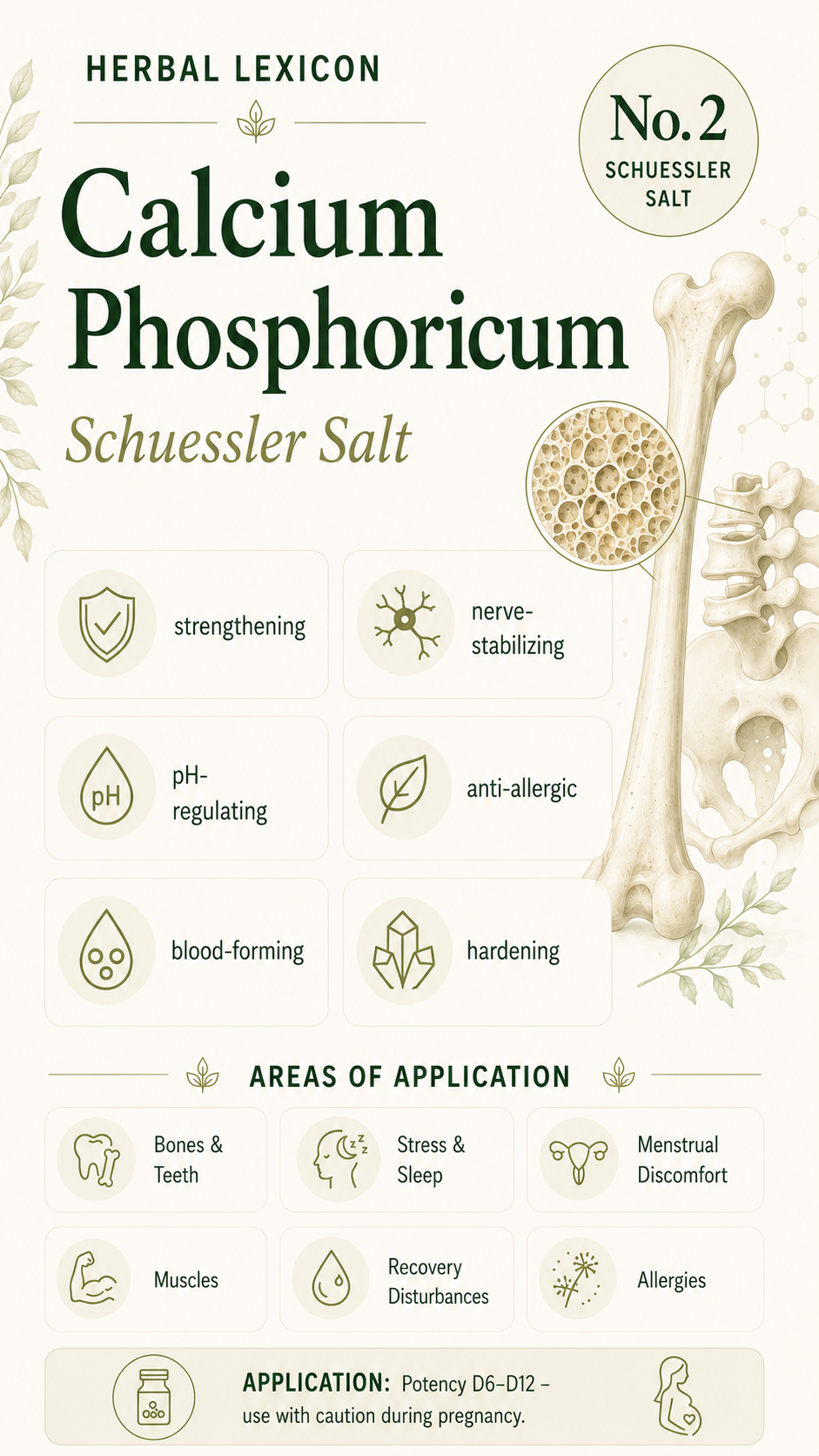


Calcium phosphoricum is the body’s stabilizing agent—it is present wherever hardness and strength are needed.
Interesting facts about Calcium phosphoricum
Calcium phosphate is ubiquitous in both the human body and industry.
- Bone substitute material used in implantology is made of calcium phosphate.
- Listed as E341 on food labels.
- It was also an additive in vaccines.
Effects & Properties
Calcium phosphoricum strengthens bones, teeth, and tendons. Phosphate residues stabilize the nerve potential – The nervous system functions more stably and calmly. It inhibits the release of histamine (antiallergic) and plays an important role in the coagulation cascade, as calcium ions are essential for blood clotting.
Features: toning, firming, pH-balancing, anti-allergic, nerve-calming, blood-building.
Storage Locations & Deficiency Symptoms
Stored in bones, teeth, blood, and all cells. Symptoms of deficiency include:
- Growing pains, osteoporosis
- Allergies, anemia
- Nervousness, muscle tension
- Coagulation disorders, dental diseases
Applications
A wide range, from bones to nerves.
Calcium phosphoricum for sleep disorders and stress
Stress exhausts the nervous system—a deficiency of calcium and phosphate in the nervous system increases the excitability of nerve cells. This sets off a vicious cycle of overstimulation and sleep deprivation. The phosphate group in the compound stabilizes nerve potential and serves as an energy source for the nervous system. Calcium phosphoricum breaks this cycle: the nervous system calms down, and sleep returns.
Calcium phosphate for coagulation disorders
Calcium ions are an essential component of the coagulation cascade—without them, blood cannot clot quickly enough at wound sites. In cases of coagulation disorders or delayed wound healing, Calcium phosphoricum provides the necessary calcium ions to promote faster wound closure and reduce blood loss.
Calcium phosphoricum for menstrual cramps
Menstrual cramps are caused by spasmodic contractions of the uterine muscles, which are exacerbated by an overstimulated nervous system. Calcium phosphoricum calms the overstimulated nervous system and reduces the excitability of the smooth muscles. The cramps become less severe, and the pain subsides.
Calcium phosphate for muscle tension
Muscle tension occurs when the nervous system continuously sends signals to contract the muscles—a constant stimulus that exhausts the muscles and causes them to become painful. Calcium phosphoricum reduces this constant nervous stimulation by stabilizing nerve potential. The muscles relax, the tension eases, and a sense of relaxation returns.
Calcium phosphate for strong bones and teeth
Bones and teeth are largely composed of calcium phosphate—if the body lacks a steady supply, they become brittle and porous. This can lead to osteoporosis and dental problems. Calcium phosphoricum provides the building block the body needs to strengthen bones and mineralize teeth. It is especially important during growth spurts, after fractures, and for the prevention of osteoporosis.
Instructions for Use
For long-term use in cases involving bones and teeth. For allergies, take orally throughout the day. May also be applied topically as an ointment.
Pregnancy & Breastfeeding
Rest assured—children also need calcium phosphate for their bone health.
Duration of use
Structural issues (bones, teeth): long-term use over several months. Acute issues (stress, sleep): short-term use is also possible.
Profile
- Content: Calcium phosphate
- Description: Salt in the bones and teeth
- Distribution: Bones, teeth, blood plasma, all cells
- Schüssler No.: 2
- Typical potency: D6–D12