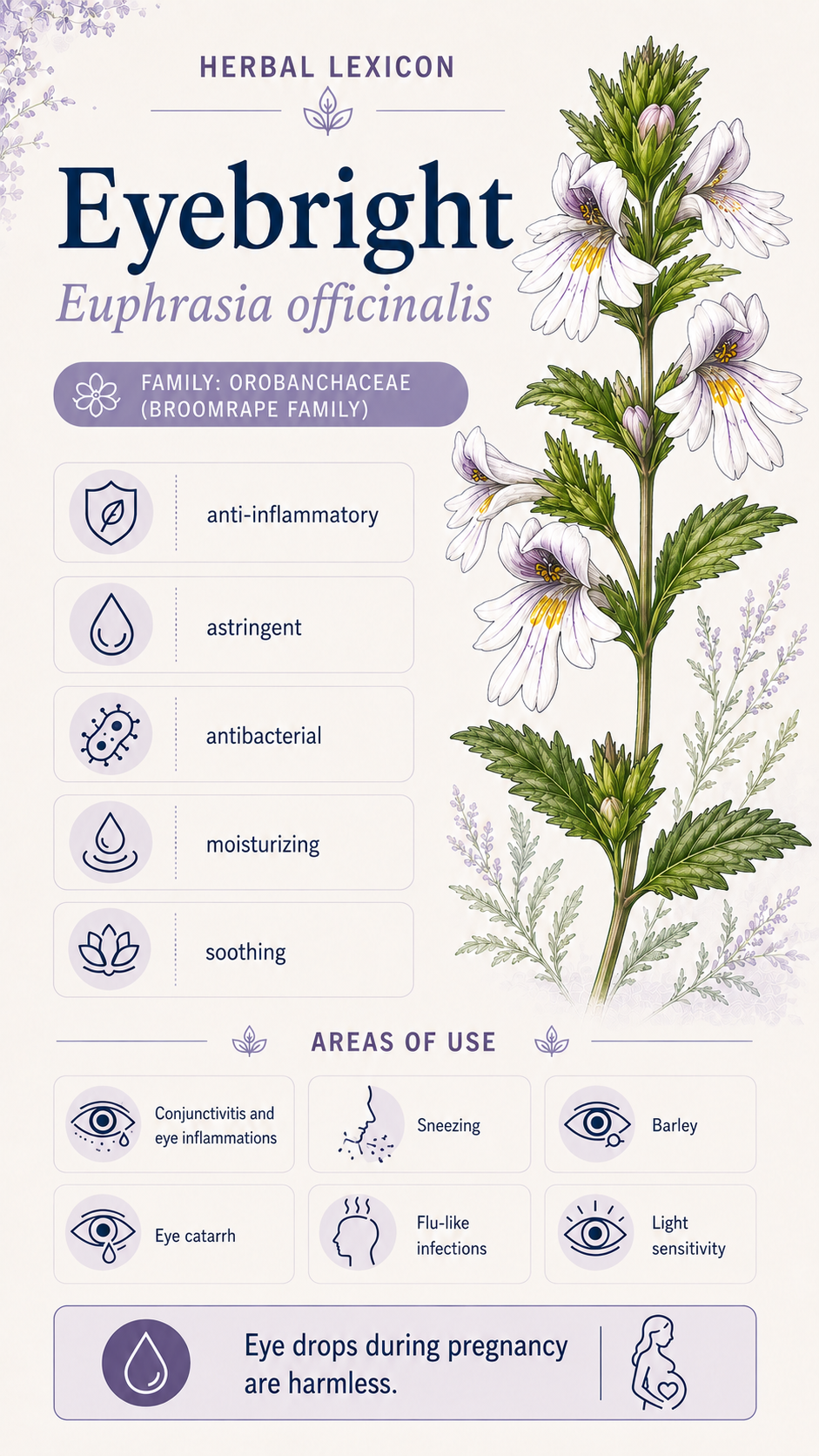

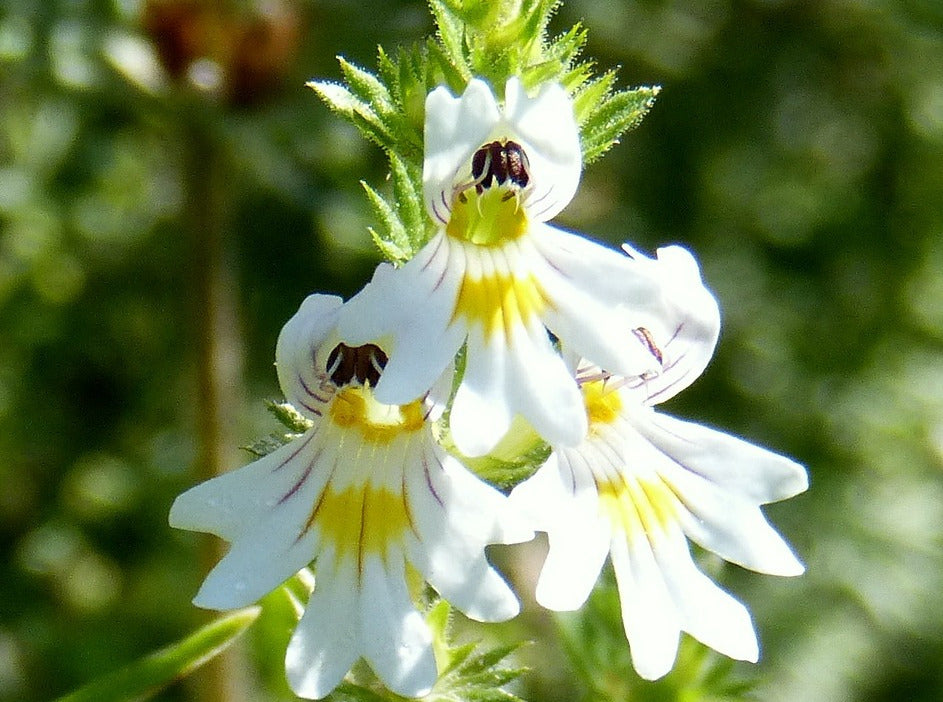
When you walk through our grasslands with your eyes open, eyebright always catches your eye. Its distinctive white flower, with purple veins and a yellow spot, is both striking and pleasing to the eye. Here, eyebright is one of the three most important plants used to treat eye conditions—it has been used successfully in ophthalmology for over 700 years.
Interesting facts about eyebright
- Alpine farmers pull out eyebright because it reduces their cows' milk yield—it acts as a parasite on the roots of meadow grasses.
- Until 2003, the eyebright used in medicines was always harvested from the wild.
- The French call it "Casse-lunette"—"glasses breaker"—because it's said to improve eyesight.
Effects & Properties
Eyebright is a semi-parasite: it can sustain itself entirely on its own, but uses sucker roots to tap into the roots of other plants. In naturopathy, it is particularly effective for treating mucous membranes and conjunctiva. The iridoid glycosides have anti-inflammatory effects, the tannins causing blood vessels to constrict, which Flavonoids antibacterial and antiviral. This combination makes it the right choice for nearly all eye conditions—whether bacterial, viral, allergic, or caused by dry air.
Features: anti-inflammatory, astringent, soothing, moisturizing, antibacterial.
Applications
Eyebright is a specialist—its uses all revolve around the mucous membranes and conjunctiva, particularly in the eye.
Euphrasia for hay fever
With hay fever, wind-borne pollen comes into contact with the mucous membranes of the nose and eyes. These membranes respond with an inflammatory reaction—they become inflamed, swollen, and watery. The eyes itch and burn, and the nose runs uncontrollably. Eyebright counteracts this allergic reaction: the iridoid glycosides reduce inflammation, while the tannins constrict the swollen blood vessels. The eyes stop watering and itching, and overall well-being improves significantly.
Euphrasia officinalis for conjunctivitis
Whether caused by viruses, bacteria, dust, or dry air, conjunctivitis involves inflammation, redness, and swelling of the thin mucous membrane that covers the eye. Eyebright eye drops are applied several times a day: The iridoid glycosides directly inhibit the inflammatory response, while the tannins constrict the dilated blood vessels. Redness, itching, and sticky eyelids subside, and the eye is soothed.
Eyebright for eye and nasal catarrh
The eyes and nose are anatomically connected—the nasolacrimal duct links the two. In cases of catarrh, the eyes and nose are usually affected simultaneously, with both mucous membranes involved. Thanks to its iridoid glycosides and tannins, eyebright reduces inflammation, alleviates swelling of the mucous membranes, and normalizes excessive secretion. At the same time, the flavonoids combat viruses and bacteria.
Euphrasia officinalis for flu-like infections
Cold viruses that affect the entire eye-nose tract cause the mucous membranes to become sore, irritated, and overly secretory. Eyebright specifically soothes the mucous membranes: its tannins constrict dilated blood vessels, while its iridoid glycosides have an anti-inflammatory effect. The soreness in the eyes and nose subsides, and the immune system is relieved.
Eyebright for styes
A stye is a purulent staphylococcal infection on the edge of the eyelid—a small, painful inflammation that significantly affects vision. Eyebright, with its antibacterial and anti-inflammatory properties, helps alleviate symptoms and supports the body’s natural defenses. If the condition persists or symptoms worsen, you should consult an ophthalmologist.
Euphrasia officinalis for light sensitivity
Severe conjunctivitis can alter the eye’s refraction and cause severe sensitivity to light. Any light is painful, and it is difficult to open the eye. Eyebright targets the underlying cause of the inflammation: the inflammation of the conjunctiva subsides, the eye calms down, and sensitivity to light returns to normal.
Instructions for Use
Eyebright is available in pharmacies as a ready-to-use medication in the form of eye drops—to be used up to 5 times a day in each eye. It is also available for oral use as an ingredient in homeopathic combination remedies for cold symptoms.
Pregnancy & Breastfeeding
There is no reason not to use eyebright as eye drops during pregnancy—topical application to the eye is considered safe.
Plant Profile
- Scientific name: Euphrasia officinalis
- Plant family: Broomrape family (Orobanchaceae)
- Other names: Milk Thief, Meadow Wolf, Eye of Thanks
- Flowering period: July through September
- Origin: Native to (Europe, up to 2,300 m)
- Toxicity: Non-toxic